

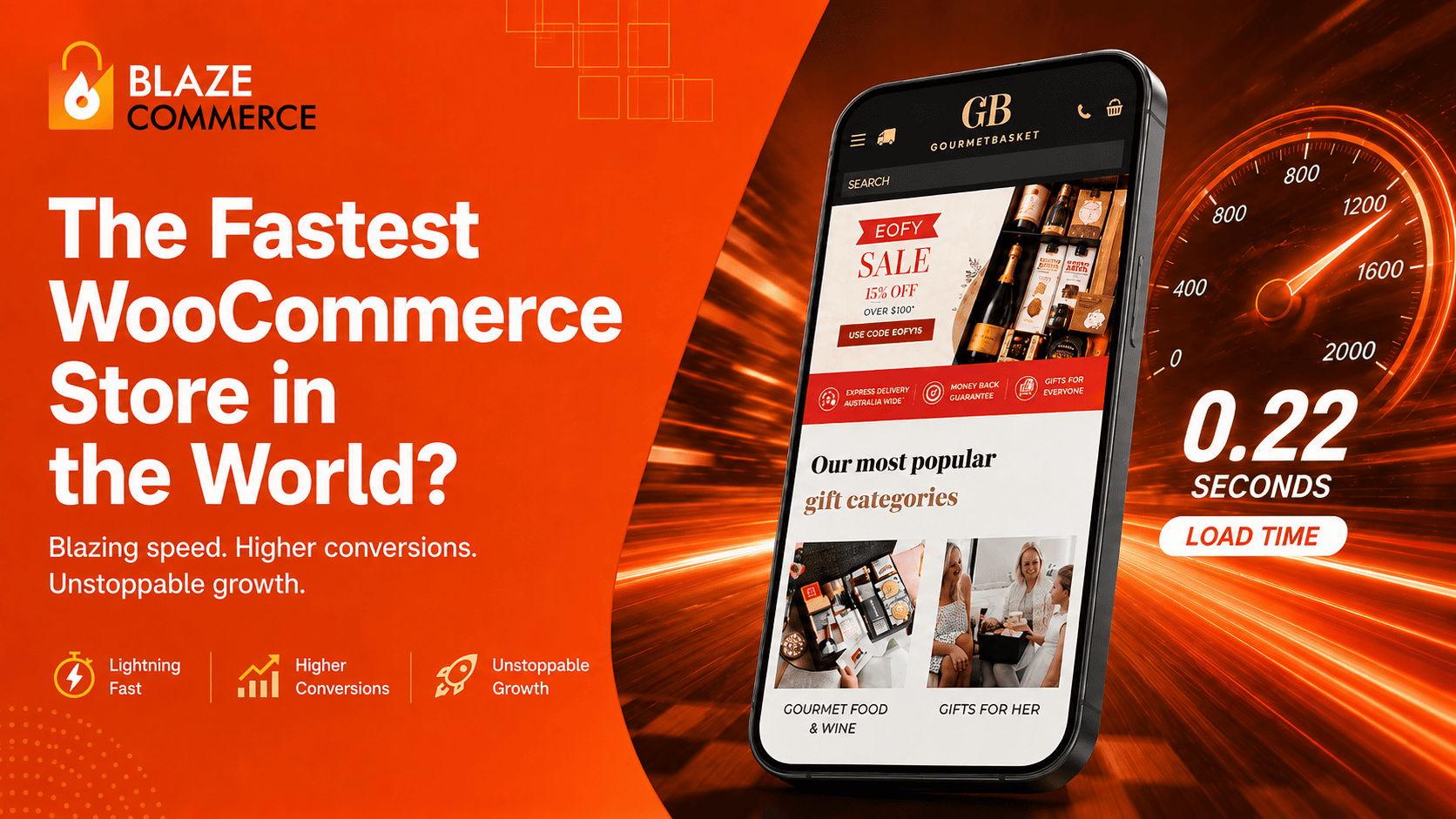
After 9 years of pushing WooCommerce to its limits, Gourmet Basket faced a crisis that threatened their biggest revenue period: their checkout was timing out during peak season.
For a luxury gift hamper retailer that processes three months of revenue in a single week during the Christmas rush, checkout failures were not an inconvenience. They were hundreds – possibly thousands – of orders disappearing as customers abandoned their carts. Baymard Institute puts the average cart abandonment rate near 70% even when checkout works; a checkout that times out turns that number into a catastrophe during your highest-volume week.
Bottom line: Gourmet Basket went headless in 2022 and reached 0.223-second page loads, a 30% revenue lift, and a 60-day payback – without leaving WooCommerce. This is what headless looks like when it is the right call. Most stores are not here, and that distinction is the point of this story.
A note before we start: this case study gets into performance numbers and architecture. If that is your world, the detail is all here. If it is not, the short version is simple: a WooCommerce store this large was buckling under load, headless fixed it, and the same speed is reachable for most smaller stores through optimization instead. Skip to the FAQ for what that means for your store.
The challenge was not only speed. Gourmet Basket had built their entire operation around WooCommerce, with deep integrations into:
- Cin7 for inventory management
- Klaviyo for email marketing
- Keap for CRM
- Ordoro for marketplace integration
- Shipping systems for automated fulfillment
- Warehouse management systems for order processing
Along with a host of other integrations and performance work that lets them process large volumes of orders in short windows. Migrating to another platform would mean rebuilding years of business logic and workflows. It was not an option.
The Performance Ceiling That Could Not Be Broken
Over the years, we had tried everything. Server upgrades. Caching. Database tuning. CDN implementations. Each improvement bought time, but the underlying problem stayed put: under heavy load, a monolithic WooCommerce setup slowed down faster than hardware could keep up.
The more traffic climbed, the slower the site got. During peak periods the checkout – the most critical conversion point – would grind to a halt. Pages that loaded in 2-3 seconds under normal conditions stretched to 10, 15, even 20 seconds under high traffic.
For a business doing 12x its normal weekly revenue during Christmas, every second of delay meant lost orders. After 9 years of partnership, we knew there had to be a better answer than fighting the same battle every season.
The Solution: Headless, Without the Headaches
In 2022, we proposed something different: headless WooCommerce architecture. Going headless is not only a technology decision, though. It is about understanding WooCommerce deeply enough to keep everything that makes it work for the business while removing its performance ceiling.
This is where a decade of WooCommerce focus matters. A generalist agency might have suggested starting over on Shopify or a custom build. We knew Gourmet Basket’s success depended on keeping their existing workflows intact.
Keeping the Business Running
The biggest worry for any WooCommerce store weighing headless is whether the team will have to change how they work. For Gourmet Basket, the answer was no:
- The same WooCommerce admin for products, pricing, and orders
- No new systems to learn and no staff retraining
- No workflow disruptions
- All existing integrations continued working exactly as before
The team managed the store the way they always had. What changed was the speed their customers experienced.
See what is realistic for your WooCommerce store.
Every store is different, but the principles that fixed Gourmet Basket’s performance crisis apply broadly. The WooCommerce Revenue Audit shows where your store sits today and what half-second page loads would take – whether that is headless or optimization on your current stack.
Start My Audit →A paid, full diagnosis tied to real numbers from your store – not generic promises. You see exactly what we would touch before we touch it.
Beyond Speed: A Full UX Rework
Solving the performance crisis was priority one, but we did not stop there. Using our integrated UX evaluation process – built over more than a decade of ecommerce work and informed by Baymard Institute research – we reworked the site experience with a mobile-first approach. The full method is in our WooCommerce UX guide.
This was not about opinions or trends. Every UX decision was backed by data from user research, so that once customers could load pages quickly, they met an experience built for conversion.
Partnership Implementation: Building for the Long Term
This was not a “launch and disappear” project. After 9 years of working together, Gourmet Basket knew what to expect from Blaze Commerce. As Stuart Mills, Managing Director, puts it:
“Blaze Commerce listens to what we want and takes the time to understand the business issue we’re trying to solve so they can give us the best practice way to achieve it.”
The implementation reflected that partnership:
- Detailed discovery to map every integration and workflow
- Phased migration with zero business disruption
- Extensive testing, particularly for peak load
- Post-launch optimization based on real user data
- Ongoing monitoring to catch issues before they hit revenue
Six months after starting, the new headless site went live. The results were immediate.
The Numbers That Matter
Performance Metrics
Using independent testing tools, here is how Gourmet Basket performs:
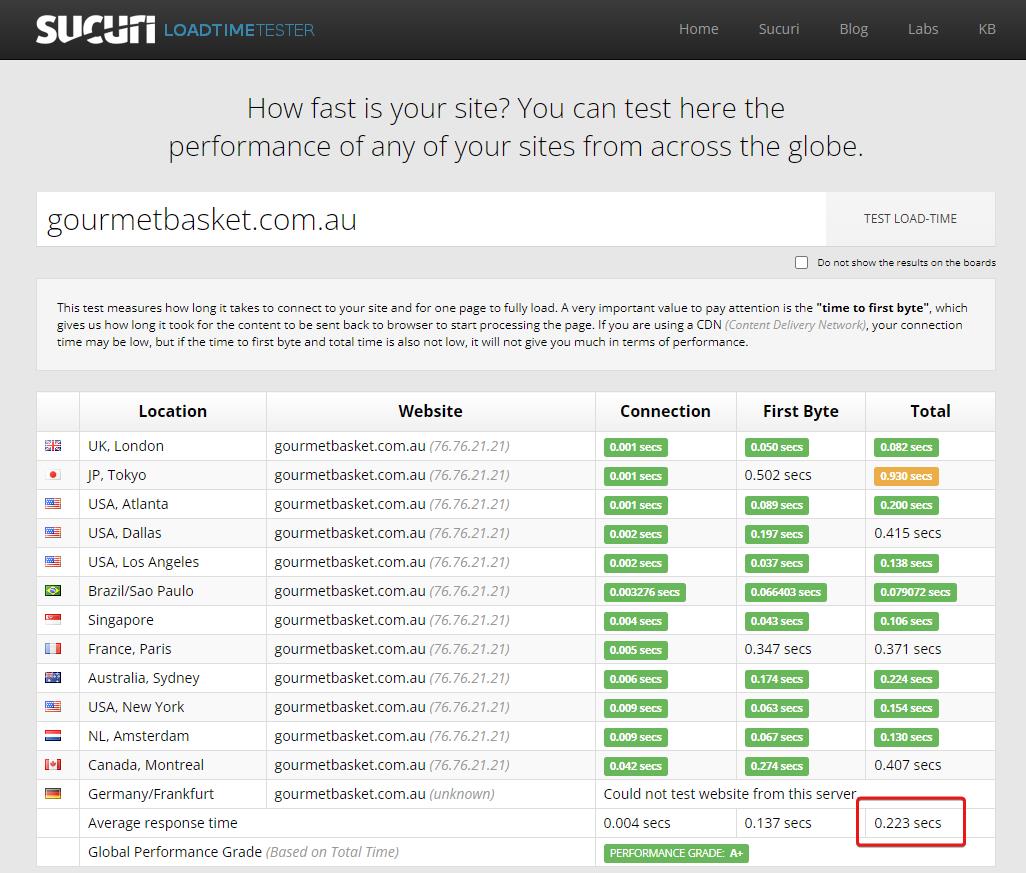
Initial Page Load: 0.223 seconds
- Faster than Nike (0.224 seconds)
- Faster than H&M (0.275 seconds)
- Faster than Target (0.727 seconds)
- Faster than Amazon (0.751 seconds)
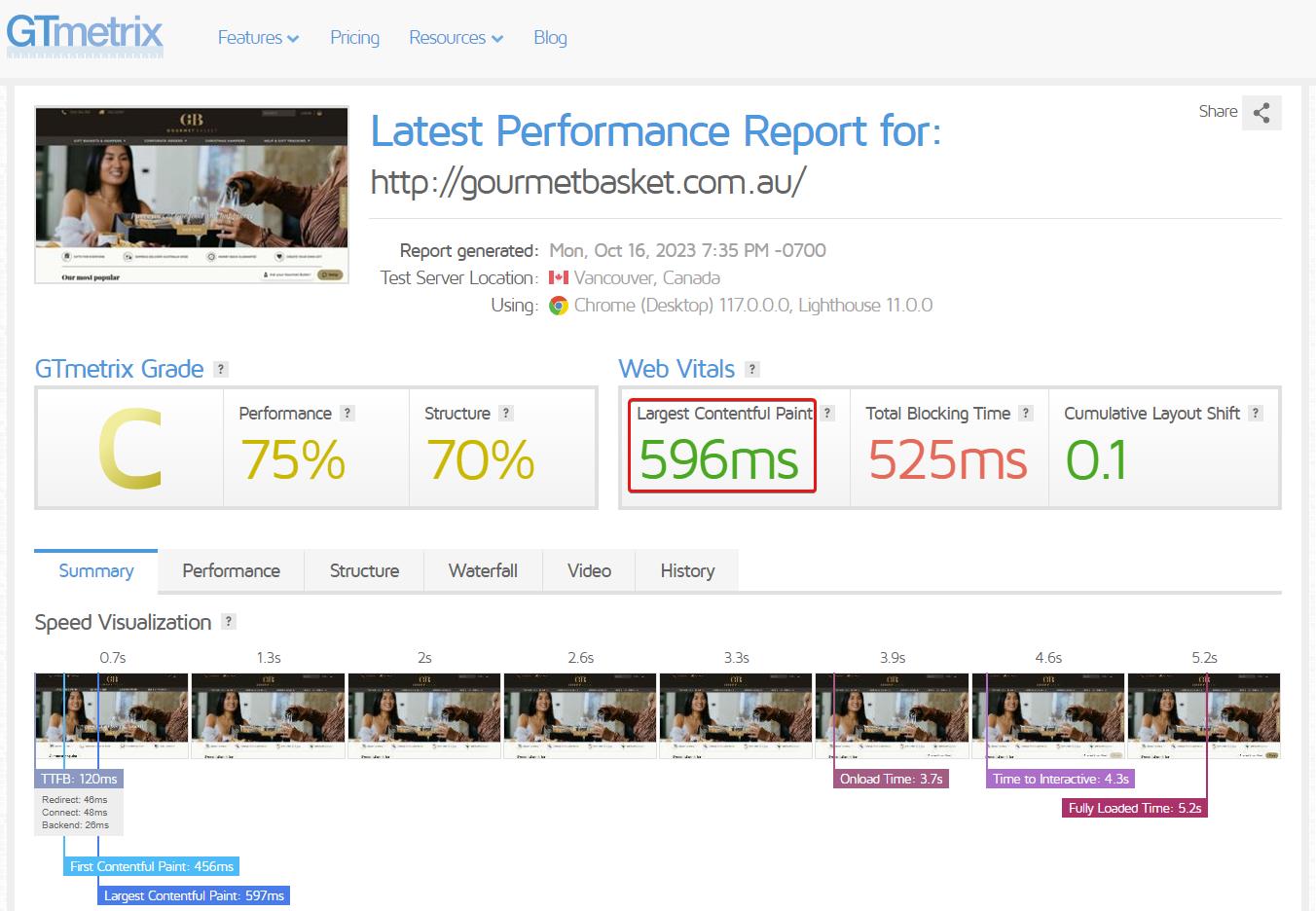
Largest Contentful Paint: 596 milliseconds
- Well under Google’s 1-second target for Core Web Vitals
- Faster than 95% of ecommerce stores tested
Business Impact
Speed is a means to an end. Here is what it produced:
- 30% revenue increase year-over-year
- 73% improvement in mobile site speed
- 30% reduction in bounce rate
- 60-day ROI – the project paid for itself in two months
- Zero downtime through two years of peak seasons
- Zero checkout timeouts, even during the Christmas rush
Stuart Mills confirms the change:
“Switching to Blaze Commerce’s headless WooCommerce has been a game-changer for our store. We’ve seen a 73% improvement in mobile site speed, and our bounce rate dropped by 30%.”
See where your store stands today.
A 30% revenue lift and 60-day ROI are real outcomes – for the right store, with the right approach. The WooCommerce Revenue Audit shows where your store sits today and what is realistically achievable, with the numbers behind it.
- ✓Real data from your store
- ✓Reviewed by humans, not bots
- ✓Every finding tied to a dollar figure
A paid, full diagnosis of your store. We tell you what to fix and what it is worth, whether you hire us or not.
Peak Season Performance
Remember that Christmas week when they process three months of revenue? The real test of an ecommerce platform is not a Tuesday afternoon in March. It is your biggest sales days.
Two years and several peak seasons later:
- Zero performance degradation under load
- Checkout stays fast regardless of traffic
- No emergency server upgrades
- No sleepless nights through Black Friday
Competing at the Highest Level
When we tested Gourmet Basket against 600 other ecommerce stores across WooCommerce, Shopify, Magento, BigCommerce, and existing headless builds, only one matched their speed.
This is not about bragging rights. It is about giving a WooCommerce store the ability to compete with anyone, including the giants that spend millions on performance.
Your WooCommerce store should not hold you back. Gourmet Basket shows you can keep everything you rely on in WooCommerce and still reach performance that matches the biggest brands.
When Headless Is the Right Call – and When It Is Not
Gourmet Basket is what headless looks like when it is the right call. We went headless with stores like this in 2022 because it was the most reliable way to get WooCommerce loading fast under serious load. Since then, better hosting, full-site editing, and the optimization work we do have changed the math. Most stores now reach half-second page loads (460-560ms) without the cost or complexity of a headless build.
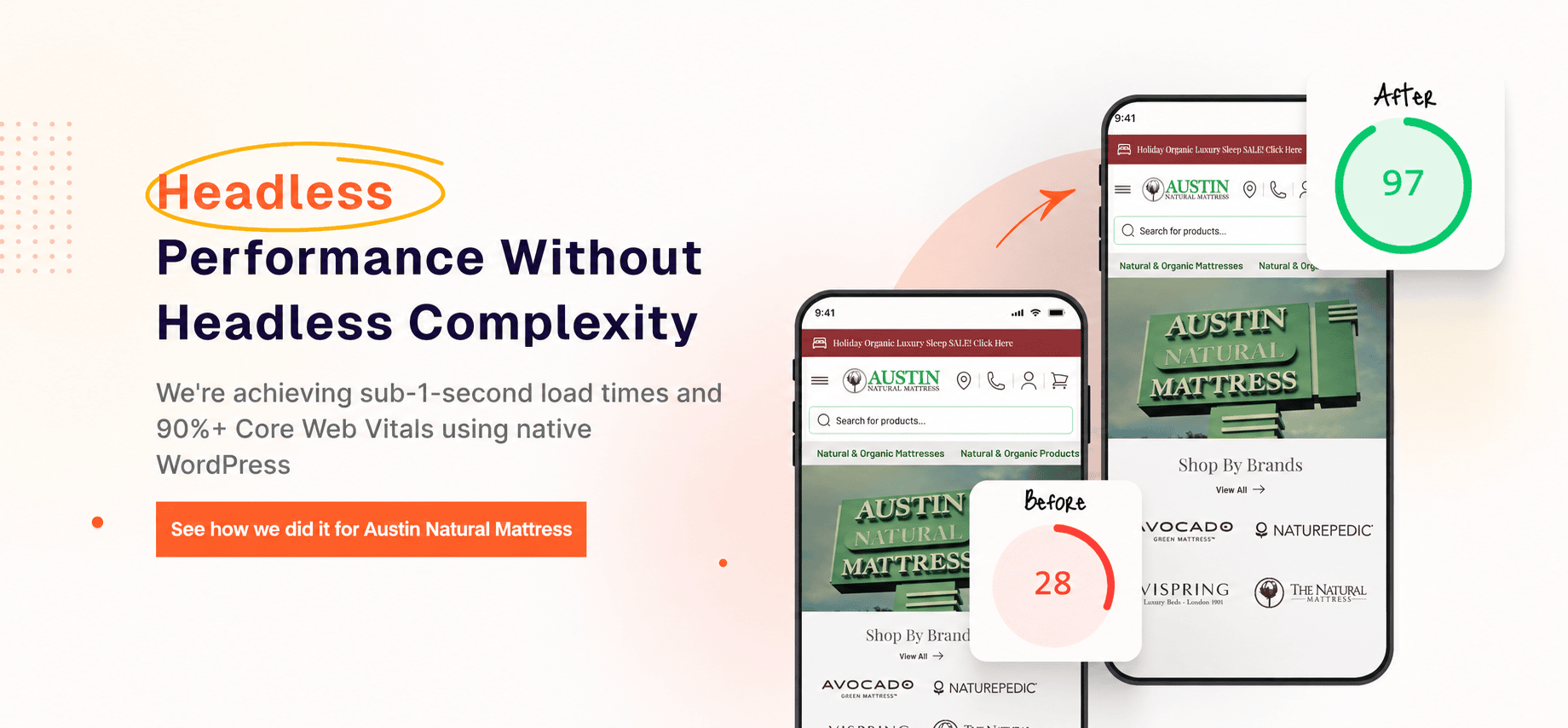
Above roughly $3M in revenue – with checkout buckling under load the way Gourmet Basket’s was – headless still earns its keep. Below that line, optimization usually gets you the same result for a third of the price. If you want the full decision framework, read when not to go headless with WooCommerce. For the stores on the optimization side, the results are every bit as real: Austin Natural Mattress and Henry Holsters both reached high performance without a headless rebuild.
The Ongoing Partnership Difference
Two years after launch, we are still optimizing Gourmet Basket’s site. This is not a set-and-forget solution. Ecommerce keeps moving, and so does the work.
Recent work has included:
- Search functionality improvements
- Mobile UX refinements based on user behavior data
- Core Web Vitals work for Google’s latest requirements
- Performance monitoring and proactive fixes
This ongoing approach is why our average client relationship spans over 3 years. We are not interested in one-time projects. We build long-term success stories.
Is Your WooCommerce Store Hitting Its Ceiling?
If you recognize any of these, you may be facing the same challenges Gourmet Basket overcame:
- Checkout slowdowns during peak traffic
- Performance that gets worse as traffic increases
- Server upgrades with diminishing returns
- Deep WooCommerce integrations that rule out a platform migration
- Mobile performance lagging well behind desktop
The answer is rarely starting over. More often it is making what you have faster – through a headless rebuild if you are a high-volume store, or through WooCommerce optimization if you are not.
Gourmet Basket kept their entire WooCommerce workflow, held onto every integration, and now performs at the level of the world’s biggest ecommerce brands. Their 30% revenue increase paid for the project in 60 days.
Frequently Asked Questions
How did Gourmet Basket reach 0.223-second page loads?
Through a headless WooCommerce build on a modern frontend framework, which renders pages as static or server-rendered HTML instead of building them in the browser on every request. Combined with optimized images, caching, and a lean frontend, that took their Largest Contentful Paint to 596 milliseconds – well under Google’s 1-second target – while keeping the full WooCommerce backend and every integration in place.
Will headless work for my store the way it did for Gourmet Basket?
Maybe not – and that is the honest answer. Gourmet Basket is a high-volume store, well above $3M a year, with checkout timing out under load. That is the profile headless is built for. If your store is smaller, a $70K+ rebuild is hard to justify when WooCommerce optimization reaches the same half-second page loads (460-560ms) for about a third of the cost. The when not to go headless guide walks through where the line sits.
Did going headless change how the team manages the store?
No. Gourmet Basket’s team uses the same WooCommerce admin for products, pricing, and orders, and every integration – Cin7, Klaviyo, Keap, Ordoro, shipping, and warehouse systems – kept working as before. The change was on the frontend the shopper sees, not the backend the team works in.
What does the WooCommerce Revenue Audit include?
A paid, full diagnosis of your store across performance, UX, analytics, and build, with the specific revenue leaks quantified and a prioritized plan. For a store weighing a rebuild, it tells you straight whether headless or optimization fits your revenue level – with the numbers behind the recommendation. Start your audit here.
Can a smaller store get this kind of speed without going headless?
For most stores, yes. The speed shoppers feel comes from the same fundamentals – efficient rendering, optimized images, caching, and a lean frontend – and those can be applied to your existing WooCommerce store through optimization. Austin Natural Mattress and Henry Holsters are two stores that did exactly that, without a rebuild.