

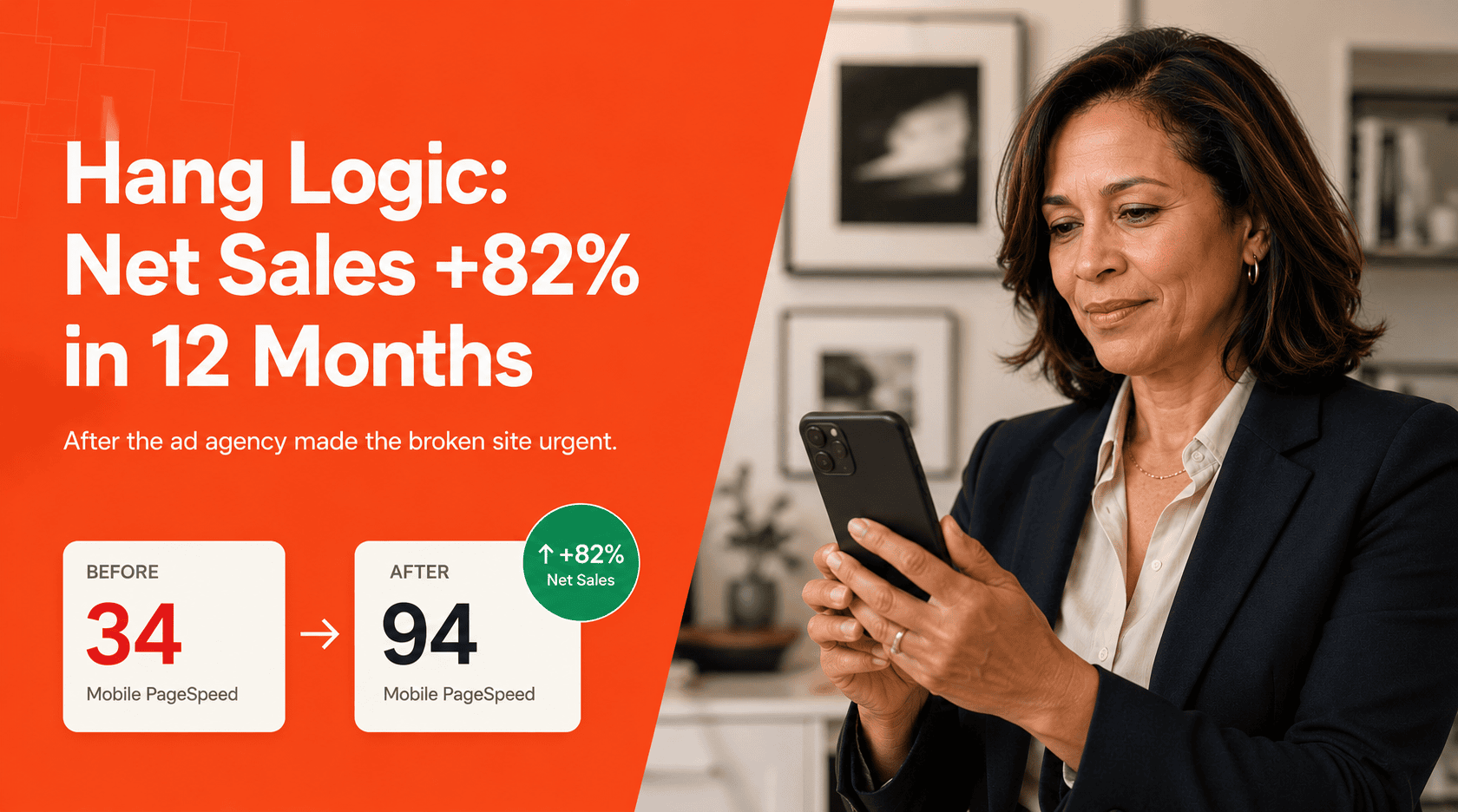
When Jacqueline Mitchell of Hang Logic first spoke with us, she had recently signed with a Melbourne ad agency to run Google Ads.
Hang Logic imports European picture hanging systems into Australia. Jacqueline had been running it for 15 years. Three or four years earlier she’d achieved a long-held goal of becoming the architect importer in Australia – the high-margin B2B channel selling to builders and architects, where one specifier could be worth ten consumer orders.
The ad spend was about to ramp. Before it did, she wrote to her new ad agency:
“I’m going to look at getting a new website because you can do some amazing advertising. But [if the site can’t convert it]…”
Jacqueline Mitchell, Business Owner, Hang Logic
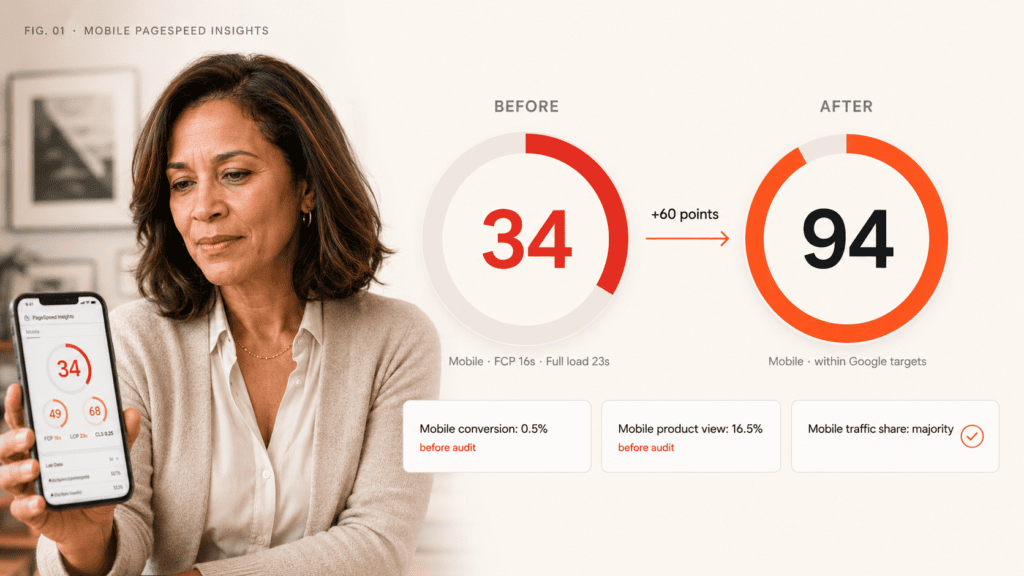
She was right. Her mobile PageSpeed was 34 out of 100. Mobile search was completely broken. 83% of mobile visitors never saw a single product on the site.
She’d been planning to address the site for a while. The ad agency made it urgent.
The TL;DR:
- Net sales up 82% Q1 2026 vs Q1 2025. Orders +45%. AOV +25%. Same store, working properly.
- Mobile PageSpeed 34 → 94 out of 100. First Contentful Paint was 16 seconds. Full page load was around 23 seconds. With paid traffic about to hit the site at scale, every bounce was now metered.
- The mobile product view rate was 16.5%. 83 out of every 100 mobile visitors left without seeing a single product. Replaced search, restructured categories, reworked product discovery – visitors now land on products.
- No starting over. Same URL, same content, same orders, same customer data. We replaced the underlying theme and resolved the failing UX areas. Hang Logic kept everything that worked.
- The ad spend was working. The site finally was too. A Melbourne agency was about to run Google Ads. The site they’d be sending traffic to couldn’t convert it. We resolved that before the spend ramped.
Project went live October 8, 2025.
A note before we start: this case study gets into PageSpeed scores, UX failures, and the WooCommerce build underneath them. If that’s your world, the detail is all here. If it isn’t, the short version is simple – Hang Logic’s mobile store was slow and hard to buy from, we resolved that on the same site she already had, and the same customers started ordering more. Skip to the FAQ for what that means for your store.
The ad agency trigger: when paid traffic exposes a broken site
Most clients reach us with a slow leak. Hang Logic was different. The leak hadn’t started yet – but it was about to, and Jacqueline was the one who saw it coming.
She’d signed the contract with the agency. The campaigns were being built. In a few weeks, paid traffic was going to start hitting her site at a volume her organic traffic never had. The way she put it to her new agency was the right way to put it: amazing advertising sending people to a site that couldn’t convert them is an expensive bounce rate.
That diagnosis – that the ad spend wasn’t the problem and wasn’t the answer until the site could carry it – is the diagnosis most owner-operators don’t make until after they’ve spent the budget. Jacqueline made it before. That changed the sequence of what got resolved first.
What was broken
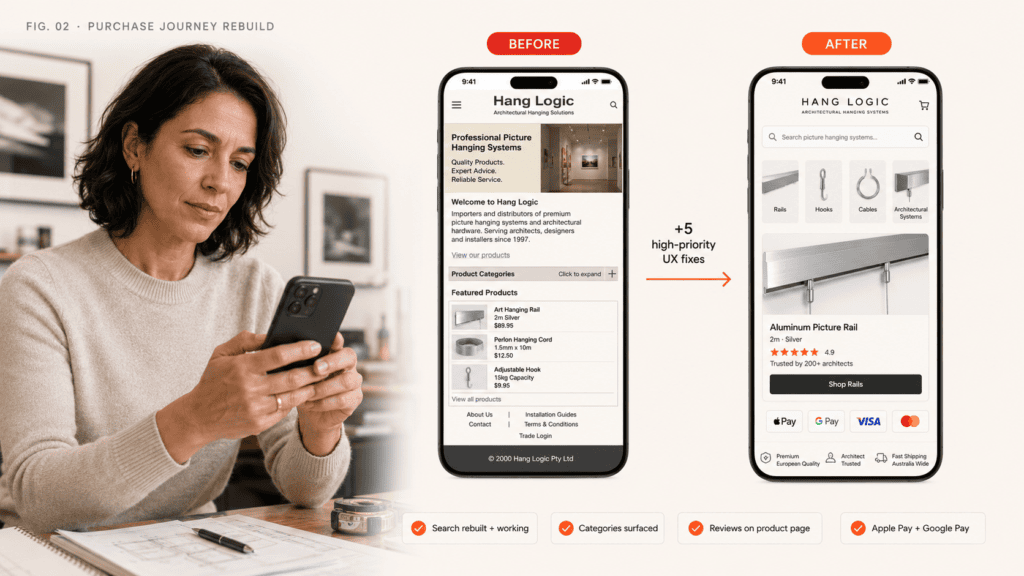
Our diagnostic process looks at four layers – UX, performance, analytics, and the underlying WooCommerce build – developed across 11 years and hundreds of WooCommerce engagements. On Hang Logic, the failures clustered in the UX of the purchase journey and the performance underneath it. For the UX layer we draw on the Baymard Institute’s ecommerce research alongside the patterns we’ve seen across hundreds of stores; against that standard, the site rated poor across the board on mobile.
The failing areas, in order of impact on the purchase journey:
- Product discovery. Only 16.5% of mobile visitors viewed a product page (typical for ecommerce is 50% or more). The other 83 out of 100 left without ever seeing what Hang Logic sold. Categories were buried behind clunky expand-to-reveal navigation. Product images were small and difficult to scan on a phone. The single most important step in the purchase journey – getting a visitor onto a product – was failing five times out of six.
- On-site search. Broken on mobile. Jacqueline hadn’t realized. “Wow! The search function isn’t working. Oh, my God!” was her live reaction when we showed her.
- Trust signals. Reviews lived in the homepage footer – not on product pages where buyers make the decision. No recognized payment badges. No Apple Pay or Google Pay. For a B2B buyer placing a multi-thousand-dollar order with a small importer they’d never heard of, the trust gap was the gap.
- Visual age. The footer copyright read 2000. For a business pitching to architects and builders, a website that looks twenty years old quietly disqualifies you before the first email gets sent.
Performance was one of the failing areas. Mobile PageSpeed was 34 out of 100. First Contentful Paint was 16 seconds. Full page load was around 23 seconds. With paid traffic about to start hitting that site at scale, every percentage point of bounce rate was now metered – Hang Logic would be paying for it.
The conversion math made it stark. Combined site conversion was 1.12%. Desktop ran at 1.7%. Mobile sat at 0.5%. Mobile order value ran at roughly a quarter of desktop. The mobile audience – most of the traffic – was worth a fraction of every desktop visitor and being lost before they could become buyers.
Why this hadn’t been solved
Jacqueline isn’t a developer, but she’d built most of the site herself. Where she got stuck, she’d worked with an overseas developer – a friend of a friend, slow to respond, competent when he engaged but not a WooCommerce specialist. She’d used AI tools where she could. She’d done it on the side of running the business.
This is the DIY-then-stuck pattern. Owner-operators with the technical comfort to build a site themselves often get further than people give them credit for – and then hit a ceiling that’s invisible from the inside. The mobile site they never look at on their own phone develops broken search. The categories they restructured for SEO push products below the fold. The trust signals that mattered in 2018 stop being enough in 2025.
WooCommerce out-of-the-box has poor UX. There is no off-the-shelf theme that addresses the fundamental requirements of the purchase journey – not for product discovery, not for the product page, not for cart and checkout. A capable owner-operator can build a site that works for early customers. They can’t build a site that converts paid traffic at the level a marketing budget assumes.
That gap – between what a homemade site can do and what an ad agency’s media spend requires – is where Hang Logic was when the campaign was about to start.
We’ll show you exactly where your store loses revenue.
We audit your store across UX, performance, and conversion, then show you the specific issues costing you orders – each one measured against revenue impact. You get a prioritised list of what’s losing money and what it’s worth to resolve.
- ✓239-point Baymard UX audit
- ✓Core Web Vitals + LCP + CLS benchmark
- ✓SemRush health benchmark
Every finding comes with the revenue it’s costing you and the lift from resolving it. You decide what’s worth doing.
What we did – on the same site, working properly
We don’t do rebuilds. In 11 years, we’ve never told a client to start over. Hang Logic’s site after we shipped was the same site she came to us with – same URL, same content, same orders, same customer data. What changed was the underlying theme, the failing UX areas across the purchase journey, and the performance configuration. Same store, working properly.
The work was diagnosing the specific failures across those four layers and resolving each one.
UX changes across the purchase journey
- Product discovery reworked. Categories surfaced on the homepage and in mobile navigation. Product grid restructured so visitors landed on products, not on copy. Product images sized for mobile reviewing, not desktop print catalogs.
- On-site search replaced. New search with proper indexing and typo-tolerance on mobile. The thing Jacqueline hadn’t realized was broken now worked.
- Trust signals added. Customer reviews surfaced on product pages. Payment badges added. Apple Pay and Google Pay enabled at checkout for the mobile audience that wouldn’t enter a card number on a phone keyboard.
- Visual refresh. The design moved from twenty-year-old homemade to current. The footer no longer reads 2000.
- Cart and checkout restructured – guest checkout, fewer fields, clearer steps.
Performance work supporting the UX changes
- Replaced the bloated theme that had been carrying years of plugin debt
- Standard performance optimization across homepage, category, product, cart, and checkout
- Mobile PageSpeed 34 → 94
Project went live October 8, 2025.
Results: Net Sales +82%, Orders +45%, AOV +25%
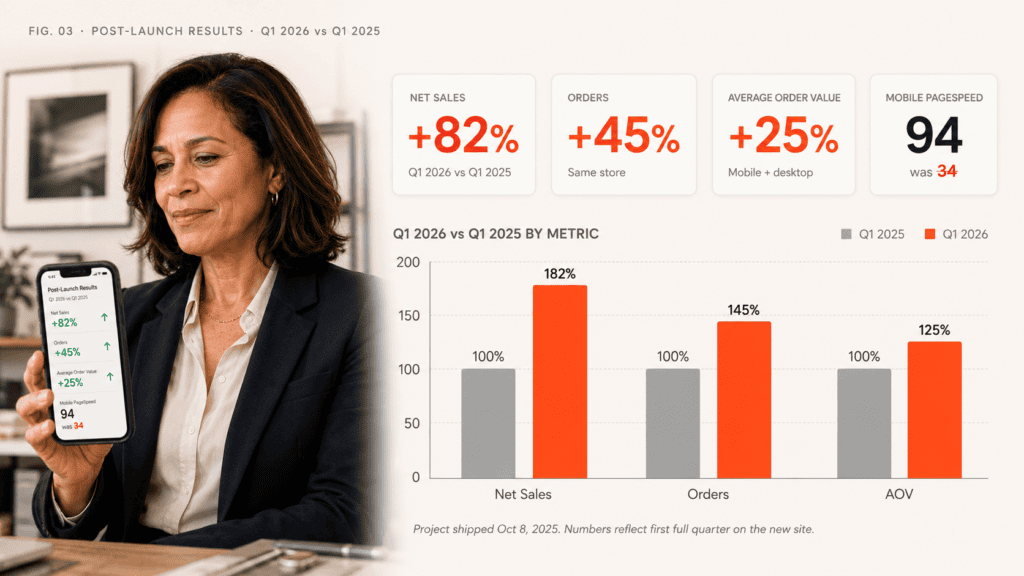
Comparing the first full quarter on the new site (Q1 2026) against the same quarter one year earlier (Q1 2025):
| Metric | Change |
|---|---|
| Net sales | +82% |
| Orders | +45% |
| Average order value | +25% |
| Mobile PageSpeed | 34 → 94 out of 100 |
Orders climbed 45%. Average order value climbed 25%. The two compound – and net sales climbed 82%.
The numbers happened because product discovery now worked. Where 83 out of every 100 mobile visitors had been bouncing without seeing a product, the reworked navigation, restructured categories, and replaced mobile search meant visitors landed on products and looked at them. Once they did, the reworked product pages and the added trust signals – reviews on product pages, payment badges, Apple Pay – closed the gap that small importers always fight when selling to high-value B2B buyers.
AOV up 25% is where the UX work shows up most clearly. The product page now does the selling work it wasn’t doing before. The cart UX lets buyers add multiple items without friction. The mobile audience – previously spending a quarter of what desktop visitors did – is now converting closer to its potential. Speed alone doesn’t lift AOV. UX work across the purchase journey does.
The paid traffic the agency sent now hit a site that could convert it. The ad spend was working. The site finally was too.
Mobile PageSpeed 34 → 94 is the foundation that made the UX work effective. Without sub-second mobile loads, the reworked product discovery still feels slow. The replaced search still feels slow. The trust signals never load before the visitor leaves. Speed alone wouldn’t have lifted net sales 82% – the UX work did that. But the performance work is what made the UX work register.
What Jacqueline said – including the parts we don’t usually publish
Jacqueline left this Google review after the project shipped. We’re including the full version, including the parts that aren’t comfortable:
“I worked with Blaze Commerce on a WooCommerce website rebuild for my business, Hang Logic.
I chose them because I wanted a team that specialised in WooCommerce and could deliver a professional result, especially in terms of performance. I loved the work the design team did, and the final site performance is excellent.
The project took longer than expected and was more demanding than I imagined. That said, Campbell (the business owner) was professional throughout and willing to acknowledge where things had slipped, which I appreciated. I also worked closely with dev James, and once I realised that showing issues directly in online sessions worked better than just documenting them in spreadsheets, things became much easier.
Not a perfect-from-day-one process, but an honest and human one – we got there. My Page Speed Insights and performance are top-notch, exactly what I invested for, and I learned a lot in the process.
If you want a team that can handle the heavy lifting and stays accountable when things get complex, I recommend them.”
Jacqueline Mitchell, Business Owner, Hang Logic · ★★★★★ · read on Google
The project took longer than originally scoped. Jacqueline named that publicly. That’s the truth of the engagement – and it’s the truth of most engagements at this complexity. We’d sooner publish it than sanitize it.
(Jacqueline calls the project a “rebuild” in her review. We don’t – but we’re not editing her words.)
If your WooCommerce store looks like this
If you’re about to start spending on paid traffic and your mobile PageSpeed is below 60, or your mobile product view rate is below 50%, or you don’t know what either number is – the ad spend isn’t the problem and the ad spend isn’t the answer. You’ll be paying to send traffic to a site that can’t convert it.
If you’ve built most of your site yourself, with a developer doing the bits you couldn’t, and you’ve started to suspect the homemade ceiling is what’s holding you back – it usually is. WooCommerce out-of-the-box doesn’t address UX across the purchase journey. No off-the-shelf theme will resolve it. AI tools aren’t ready to resolve it yet either.
You don’t need a new site. You need the one you have working properly. That’s what we do.
We’ll show you exactly where your store loses revenue.
We audit your store across UX, performance, and conversion, then show you the specific issues costing you orders – each one measured against revenue impact. You get a prioritised list of what’s losing money and what it’s worth to resolve.
- ✓239-point Baymard UX audit
- ✓Core Web Vitals + LCP + CLS benchmark
- ✓SemRush health benchmark
Every finding comes with the revenue it’s costing you and the lift from resolving it. You decide what’s worth doing.
Frequently asked questions
Will paid ads rescue a broken WooCommerce site?
No. Paid traffic on a broken site buys more bounces. Hang Logic’s mobile PageSpeed was 34/100 and 83% of mobile visitors never saw a product. Sending paid traffic into that would have burned the ad budget at the same conversion rate as organic, on visitors who were now metered. Resolve the site, then turn on the spend – not the other way around.
Why is mobile PageSpeed critical for paid traffic?
Paid traffic is metered per visitor. Every bounce is a paid bounce. Mobile PageSpeed under 60 means First Contentful Paint typically over 3 seconds, which doubles bounce rate compared to a fast site. With 70-80% of WooCommerce traffic on mobile, the gap between PageSpeed 34 and PageSpeed 94 is the gap between an ad campaign that pays back and one that doesn’t.
Can DIY WooCommerce site owners hit a ceiling?
Yes – and most do. Owner-operators with the technical comfort to build a site themselves often get further than people give them credit for, then hit a ceiling that’s invisible from the inside. The mobile site they never look at on their own phone develops broken search. The categories they restructured for SEO push products below the fold. The trust signals that mattered in 2018 stop being enough in 2025. Jacqueline at Hang Logic ran a 15-year-old business and built most of the site herself before she hit the homemade ceiling.
How is Blaze Commerce different from a rebuild?
We don’t do rebuilds. In 11 years, we’ve never told a client to start over. Same URL, same content, same orders, same customer data – we keep everything that works and replace the underlying theme plus the failing UX and performance configuration. A rebuild starts from zero, breaks SEO equity, breaks plugin integrations, and frequently introduces new performance problems. Our approach preserves the business while resolving the site running on top of it.
What does Blaze Commerce’s diagnostic process cover?
Four layers, developed across 11 years and hundreds of WooCommerce engagements: UX across the purchase journey, performance, analytics, and the underlying WooCommerce build. For the UX layer we draw on the Baymard Institute’s ecommerce research alongside the patterns we’ve seen across hundreds of stores. No single layer is the work – the value is in integrating all four. Hang Logic rated poor across the board on mobile before we started.
Why did Hang Logic’s average order value go up 25%?
The product page rework and the trust signals did the work. The reworked product pages provide the supporting information buyers needed at the point of decision. Reviews moved from the homepage footer onto the product page where they influence the purchase. Apple Pay and Google Pay added at checkout for the mobile audience that wouldn’t enter a card number on a phone keyboard. For B2B buyers placing multi-thousand-dollar orders with a small importer they’d never heard of, the trust gap closing is the AOV.
What’s the difference between B2B and B2C UX on WooCommerce?
B2B buyers spend more per order and need more proof. The product page has to do harder selling work – spec sheets, reviews, trust signals, recognized payment methods, clear delivery information for commercial accounts. B2C buyers tolerate a less polished experience for lower-stakes purchases. Hang Logic served both audiences from one storefront. The B2C optimizations (faster product discovery, working search) helped both segments. The B2B optimizations (trust signals, payment badges, product page depth) lifted AOV from buyers placing larger orders.
How long does a WooCommerce optimization take?
Most projects deliver in 4-12 weeks depending on store complexity, plugin count, and scope of UX work. Hang Logic took longer than originally scoped – Jacqueline names that publicly in her Google review and we don’t edit it out. Complex projects at this scope sometimes run longer than the initial estimate. What matters is what’s shipped at the end and how it’s running a quarter later. Hang Logic shipped in October 2025; Q1 2026 net sales were 82% above Q1 2025.
Why do trust signals matter for B2B WooCommerce stores?
A B2B buyer placing a multi-thousand-dollar order with a small importer they’ve never heard of needs proof the business is real. Customer reviews on the product page (not buried in the footer), recognized payment processor badges, Apple Pay and Google Pay, a footer that doesn’t read 2000 – these are the difference between an order placed and an inquiry email that never converts. For Hang Logic, closing the trust gap was a meaningful share of the 25% AOV lift.
Should I work with an ad agency before sorting out my site?
Audit the site first. If your mobile PageSpeed is below 60, your mobile product view rate is below 50%, or your conversion rate is under 1%, the ad spend will produce a worse result than it should. Jacqueline at Hang Logic spotted this before her campaigns ramped and resolved the site first. Most owner-operators don’t make that diagnosis until after they’ve burned a chunk of budget on paid traffic the site can’t convert.
The pattern: same store, working properly – before the ad spend ramps
Hang Logic is the fourth case study we’ve shipped where the headline outcome wasn’t more traffic – it was the same store, finally able to convert the traffic it already had (and the paid traffic about to come). Net sales +82%. Orders +45%. AOV +25%. Mobile PageSpeed 34 to 94. Done without starting over, without breaking SEO equity, without a 6-month project that loses the customer data.
If you’ve built most of your site yourself and you’ve started to suspect the homemade ceiling is what’s holding you back – it usually is. If you’re about to spend on paid traffic and you’re not sure whether the site can carry it – audit first, spend second.
You don’t need a new site. You need the one you have working properly. That’s the work.
Get my Revenue Recovery Audit
We score your store against the same 245-point Baymard standard we run on every audit, benchmark your mobile PageSpeed, and send the findings within 7 days – each gap ranked by revenue impact.
Get My Revenue Audit →Every gap is tied to a dollar figure and a priority.
Talk directly with Campbell
Founder · 11 years WooCommerce
Schedule a strategy call
30 minutes with Campbell on your UX and performance challenges with WooCommerce – especially if you’re in a restricted vertical where paid ads aren’t an option.
Schedule My Strategy Call →30 minutes. No pitch – an honest assessment of where you stand.