

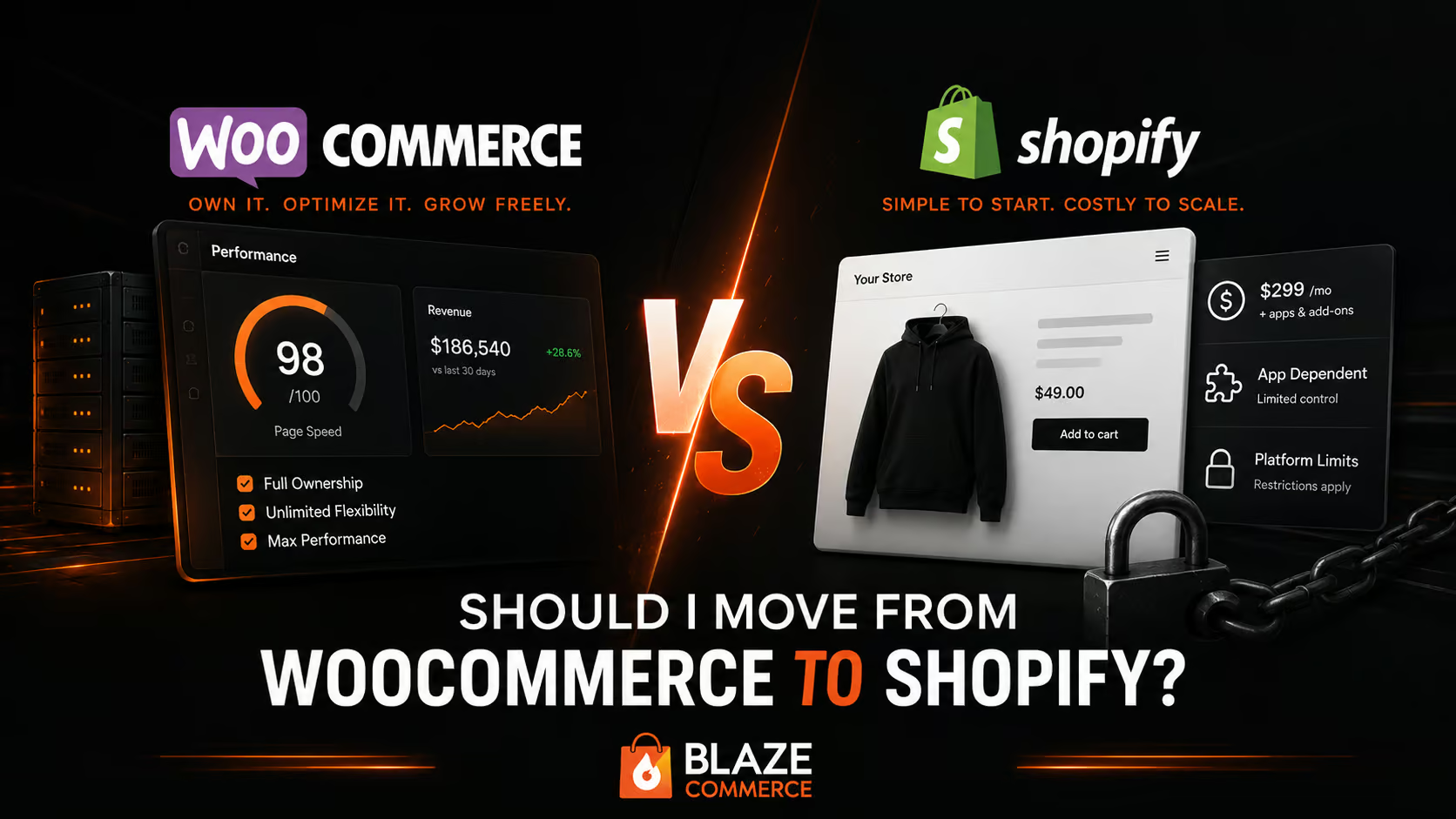
Three clients almost moved to Shopify last quarter. Here’s why two of them couldn’t.
Three of our clients asked about moving to Shopify in the last quarter.
Two of them couldn’t have switched on terms that made economic sense – their product categories sit on Shopify’s restricted list, and Shopify Payments would have refused to process their transactions. The third would have spent close to $80,000 over three years to solve a problem we resolved in eight weeks for a fraction of that.
The Shopify conversation usually starts the same way. The site feels slow. The plugins feel out of control. The agency you used last time disappeared. Shopify looks like a clean slate.
We are not going to tell you to stay on WooCommerce. We have built our business on WooCommerce since 2015, and we still send some clients to Shopify when it is the right call. This article is the diagnostic most agencies skip – the cost, performance, restriction, and migration data, all in one place – so the decision is made on facts, not on Shopify’s marketing pages.
A note before we start
This is a long, data-heavy article. If you use a screen reader or keyboard navigation, the headings are structured so you can jump between sections, and every chart image carries descriptive alt text. The fastest path through it: read the TL;DR below for the conclusion, then use the three-question diagnostic near the end to make the call on your own store. The frequently asked questions section covers the specific cases (firearms, CBD, cost, SEO, headless) if you only need one answer.
The TL;DR:
- Shopify Payments prohibits firearms, holsters, ammunition, CBD, cannabis, and tobacco outright. Many stores can’t switch at full economic terms.
- Real total Shopify Plus cost is $4,000–$10,000+ per month, not the $2,300 sticker price.
- Migration costs $25,000–$50,000 plus a 5–10% traffic dip for 3–6 months. Sloppy migrations lose 30–50% for a year.
- Shopify’s performance ceiling is ~1.5s LCP. WooCommerce done right hits sub-500ms.
- For most operators, optimization beats replatforming on every metric that matters.
If by the end you still want to move, that’s a real decision. If you decide to stay and address what’s broken, that’s also a real decision. Either way you will know why.
What does Shopify do better than WooCommerce?
Shopify is a serious platform. It is the dominant player in the top 1 million by traffic – flip to the top one million highest-traffic stores and the numbers reverse: Shopify at 15%, WooCommerce at 9.6% – and it earned that position by handling the things most merchants don’t want to think about.
There are four areas where Shopify wins out of the box.
- Default performance. Shopify leads with the highest Core Web Vitals pass rate at 58% of origins thanks to its managed infrastructure and global CDN, and ranks #1 out-of-box with a median mobile LCP of 2.1 seconds (PageSpeed Matters, CrUX Feb 2026). A new Shopify store on a stock theme is fast on day one. A new WooCommerce store on a bad page builder with $5/month hosting is not.
- Operational simplicity. Shopify handles hosting, security, PCI compliance, and updates. You log in, you sell. For a merchant with no technical capacity, that is real value.
- Shop Pay. Native one-click checkout is good. For DTC stores selling to a young consumer audience, the conversion lift is measurable. Shopify’s own data shows its checkout converts 15% better on average than other commerce platforms.
- App curation. The Shopify App Store has a review process. The WordPress plugin directory does not. Some Shopify apps still slow your store down – every platform has bloat – but the floor is higher.
That is the case. We are not pretending it isn’t real.
When is Shopify the right call?
Before we get to why most replatforms don’t make sense, here are the cases where they do.
- You have under 100 SKUs, no special checkout logic, and you ship physical products to retail consumers. Standard products, standard fulfillment, standard payments. Shopify’s defaults solve 95% of your problems.
- You have zero technical capacity AND zero agency budget. If you are running the store alone and you cannot pay anyone to maintain a WordPress install, Shopify is a better fit than a WooCommerce site nobody is maintaining.
- Your audience is young DTC and Shop Pay is a real conversion lever. If your buyers are 18–30, mobile-first, and already have Shop Pay set up from another store, the one-tap checkout is a genuine advantage we cannot replicate.
- You’re planning to exit the business inside 12 months. Acquirers prefer Shopify because it’s a known quantity for due diligence. If the goal is a clean exit, Shopify is easier to hand over.
If you fit one of those four, the rest of this article is for context. Move to Shopify.
If you don’t, keep reading.
Why do most WooCommerce-to-Shopify replatforms fail the math?
1. Your product category may not survive Shopify’s terms

This conversation ends most replatform discussions. Nobody brings it up until the migration contract is signed.
Shopify operates two overlapping restrictions: the Acceptable Use Policy (what the platform itself allows) and Shopify Payments’ Terms of Service (what Shopify’s built-in payment processor will handle). The distinction matters, because they catch different merchants in different ways.
What Shopify Payments will not process. Per Shopify’s own help center, “products or services that require regulatory approval or compliance, such as cannabis and related products, prescription drugs, medical devices, tobacco and related products, firearms, holsters, ammunition, or weapons” are prohibited from Shopify Payments (Shopify Help Center). Notice that holsters appear by name. So do ammunition and “related products” – language broad enough to capture most firearms accessories.
What the Shopify platform itself prohibits outright. Even with a third-party payment gateway, certain products cannot be sold on Shopify at all. Per Shopify’s Acceptable Use Policy: “You may not use Shopify Services to sell firearms, firearm parts or accessories, ammunition, or related products in violation of applicable law. Items such as 3D-printed firearms, solvent trap kits, and other products that may be used to manufacture untraceable firearms are prohibited” (Shopify Acceptable Use Policy).
The specific firearm items banned at the platform level are documented by Tasker Payment Gateways, a payment specialist serving the firearms industry: “Any functioning automatic weapon, regardless of FFL license… Magazine capable of accepting more than 10 rounds, Bump stock or any rapid-fire mods, Barrel shroud, Thumbhole stock, Any threaded barrel capable of accepting a suppressor or the suppressor itself, Grenade or rocket launchers of any type, A long gun with a pistol grip or in the case of a pistol, a second or forward one” (Tasker Payment Gateways).
CBD lives in a third zone. Per Shopify Help, “products containing cannabidiol (CBD) in any form are restricted” on Managed Markets (Shopify Managed Markets policy). US sellers can operate with a hemp attestation form. Canadian sellers need a cannabis licence AND Shopify Plus. And some US merchants have reported having their funds placed on hold after onboarding.
So what does “restricted” mean for a real merchant?
This is where most operators get the wrong picture. The honest version is in three parts.
Some products cannot be sold on Shopify, at all, ever. Automatic weapons, suppressors, high-capacity magazines, bump stocks – full stop. Doesn’t matter what payment processor you use. The platform won’t host the store.
Many products can technically be sold on Shopify – but not with Shopify Payments. A firearms accessories store, a holster brand, an ammunition retailer, a CBD operator can usually get a store live on Shopify with a third-party FFL-friendly or high-risk payment gateway like Authorize.Net. The platform won’t block the store by default. But here’s what they lose:
- No access to Shopify Payments. This is the cheapest rate Shopify offers. Operators on third-party gateways pay their own gateway’s rate PLUS Shopify’s surcharge – 0.5%–2% per transaction on standard plans, 0.2% on Plus. At volume, this is six figures a year in extra payment processing.
- No access to Shop Pay. Shop Pay is the conversion lever Shopify advertises hardest. It only works with Shopify Payments. So the operator paying extra for a third-party gateway also loses the conversion advantage that was half the reason to switch.
- No access to Shopify Capital. Shopify’s financing arm requires Shopify Payments. Operators on third-party gateways have no path to platform-funded growth capital.
- Permanent acceptable-use review risk. Many high-risk resellers and FFL dealers have experienced being declined or shut down by Shopify Payments. Even merchants who set up correctly can be reviewed, restricted, or terminated when Shopify’s policy team rotates through enforcement.
Some merchants find out the hard way. The pattern that hurts most is the slow one – store live, sales running, then a policy review six or twelve months in. One supplement company had their store approved initially, only to face suspension six months later when they introduced a new product line with similar ingredients to existing offerings. Recovery from that scenario is hard, because by then the operator has rebuilt their entire stack on Shopify and the cost to leave is higher than the cost to stay.
Our highest-converting verticals – firearms and tactical, CBD, cannabinoids – sit somewhere on this spectrum. None of them can use Shopify Payments. Some of them, depending on specific products in their catalogue, can’t use the platform at all. This is not a corner case. Some of our clients are doing eight figures a year on WooCommerce specifically because Shopify wouldn’t have them at full economic terms.
2. The real cost of Shopify Plus is two to four times the sticker price
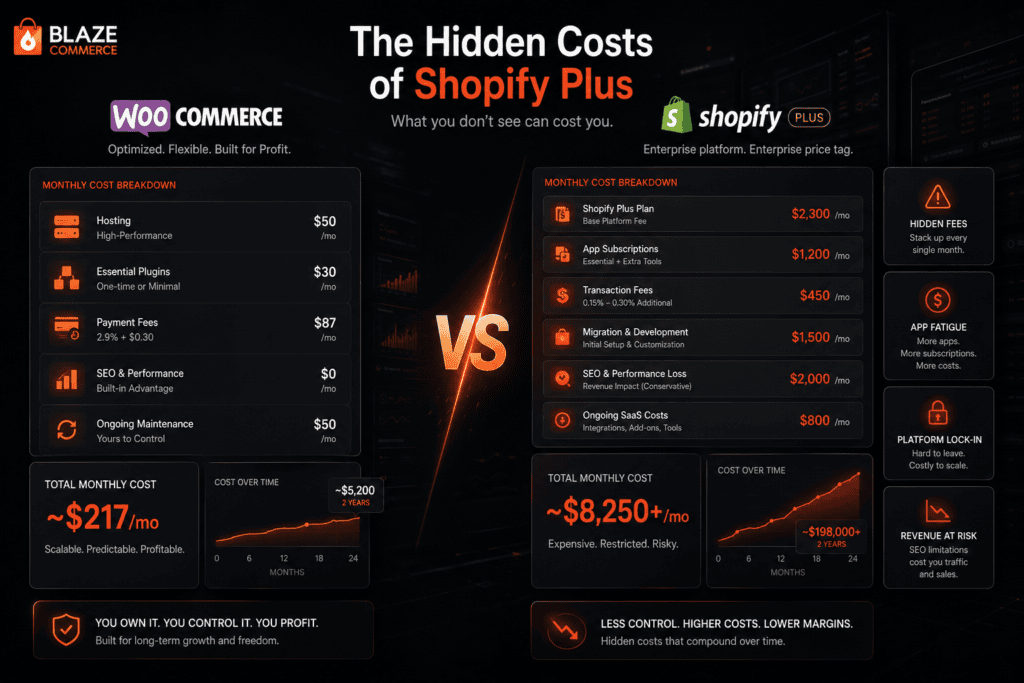
Shopify Plus is published at $2,300/month on a 3-year term or $2,500/month on a 1-year term. That is the number on the pricing page. It is also the floor.
Real total monthly costs range from $4,000 to $10,000+ depending on the store’s complexity and growth stage (BrokenRubik, May 2026). Once you cross $800,000 monthly GMV, the model changes again. Pricing transitions to a revenue-share model ranging from 0.25% to 0.40% (Nudgify, March 2026). For a store doing $10M annually, monthly Shopify costs can run $15,000–$25,000 – $180,000 to $300,000 a year before apps.
The apps are not optional. The average Shopify Plus store runs 15–20 apps, and a mid-size store with a mature app stack can easily spend $1,000–$3,000 per month on apps alone. Larger stores running heavier app stacks go higher.
Then there’s the transaction fee. Shopify adjusted its transaction fee from 0.15% to 0.2% in 2026 (Zenventory, March 2026). If you use a payment gateway that isn’t Shopify Payments – required for some verticals – that fee applies on top of your processor’s rate. On lower plans, the surcharge for not using Shopify’s gateway can reach 2% per transaction.
Compare against managed WooCommerce hosting: Kinsta at $250–$500/month for a store at this scale, no transaction surcharge, no app subscription stack, no GMV-based platform fee. The numbers stop being close at $1M annual revenue. By $5M they are not in the same ballpark.
3. Migration is a measurable, quantifiable revenue hit
Even when migrations go well, they cost.
A 5–10% traffic dip in the first month is normal, even with a clean execution. Full rankings recovery typically takes 3–6 months. Stores that skip the redirect map or do it sloppily can see 30–50% drops that take a year to claw back (Ringly, 2026 replatforming benchmarks). Shopify’s own SEO lead Kyle Risley puts it plainly: any time you change URLs, there will be some impact on SEO traffic (Shopify Blog).
The migration itself is not cheap. DIY migration tools run $300–$1,000, freelancers and small agencies $2,000–$7,500, specialist migration agencies $10,000–$50,000+ (Passionfruit, 2026 migration cost benchmarks). For complex stores with custom logic, multiple regions, or B2B/DTC overlap, costs go higher.
And then there’s the part nobody mentions: the customer support spike. WooCommerce and Shopify hash passwords differently, which means phone call volume spikes 10–30% for 1–2 weeks. Customers can’t log in (Shopify can’t import passwords, they all need to reset). They get confused emails about account invites. They can’t find their order history. Some of them will think the site has been hacked and not come back.
For a store doing $200,000/month, a 10% traffic dip for three months is $60,000 in lost revenue. The migration itself is $25,000–$50,000. Apps and reconfiguration are another $5,000–$15,000. You are $90,000–$125,000 down before Shopify has earned you a single extra dollar.
4. The performance ceiling on Shopify is lower than the ceiling on WooCommerce
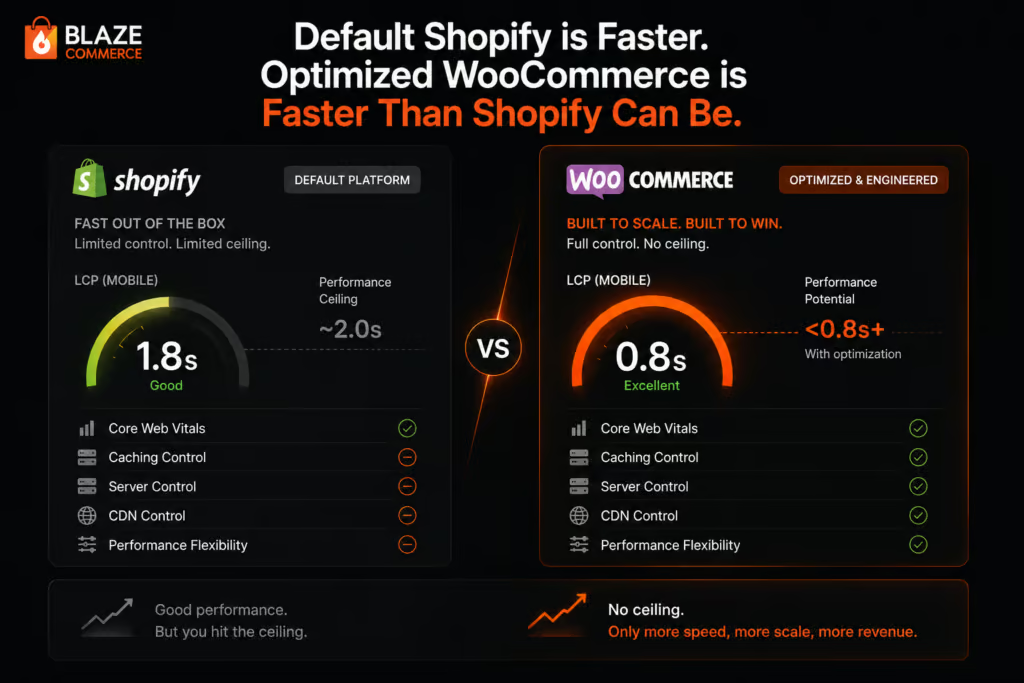
The default performance numbers favor Shopify. Most operators stop reading there. The ceiling is where the story changes.
Patrick Stox, technical SEO lead at Ahrefs, frames the dynamic: “Shopify has the best default performance floor of any ecommerce platform. WooCommerce has the best potential ceiling when correctly configured. Most analyses compare default Shopify against optimised WooCommerce, which produces misleading conclusions” (via Ighenatt SEO analysis).
The ceiling matters because it is where serious operators end up. Even optimized Shopify stores rarely achieve sub-1.5s LCP due to platform-controlled infrastructure and mandatory scripts – approximately 180KB of baseline JavaScript Shopify forces onto every page. You can optimize within Shopify’s boundaries; you cannot remove what Shopify makes mandatory.
WooCommerce has no such ceiling. Our client Cannaclear achieves a 462ms Largest Contentful Paint. High Country Off Road sits at 556ms. Choice Ammunition delivers document response in 280ms. Every one of those numbers is below half a second. Every one of those numbers is faster than Shopify’s median mobile LCP can ever be.
If half-second page loads matter to your conversion rate – and at 70–80% mobile traffic, they do – you cannot get there on Shopify. You can only get there on WooCommerce, done right. The mechanics of how are covered in our WooCommerce Performance Guide.
Have us run the diagnostic on your store directly.
You can spend weeks calculating the true cost of a Shopify migration. The $995 WooCommerce Revenue Audit shows you the answer – including which of your products would survive Shopify’s terms and what optimization would deliver instead.
- ✓Full platform-fit assessment
- ✓Revenue impact per failed pattern
- ✓Prioritized, costed plan
Real data from your actual store. We’ll tell you whether Shopify or WooCommerce-done-right is the better path for you.
What does Shopify NOT resolve that operators think it will?
Most reasons people give for moving to Shopify don’t survive contact with the data.
“Shopify will be faster.” Not faster than your WooCommerce store could be. Default Shopify is faster than default WooCommerce. That tells you nothing about what your store could be on WooCommerce with the right hosting, theme, and architecture. Migration for speed is the most expensive way to solve a problem that costs a quarter as much to resolve on your existing platform.
“Shopify will end the plugin chaos.” Shopify apps are plugins with a different name and an app store review. The average Shopify Plus store runs 15–20 apps. Each one adds JavaScript, request overhead, and recurring monthly cost. The mess doesn’t go away when you switch platforms – it changes name and starts billing you monthly.
“Shopify will reduce maintenance.” You are exchanging one type of maintenance for another. WooCommerce maintenance is patching plugins, monitoring hosting, watching for theme conflicts. Shopify maintenance is managing app subscriptions, watching for app updates breaking your theme, managing the inevitable Liquid template rebuild every 2–3 years when Shopify changes a major API. You are not removing the maintenance burden. You are paying $4,000–$10,000/month to outsource a different version of it.
“Shopify converts better.” On average, yes. Shopify averages 1.4% conversion. WooCommerce averages 2.0% (Hire Mika, 2026 benchmarks). But “averages” includes every abandoned WooCommerce store on shared hosting with a Divi theme and 70 plugins. Our clients aren’t average. Optimized WooCommerce stores beat Shopify averages and beat Shopify ceilings.
What hidden costs do most operators miss?
If you’ve made it this far, you’re probably running the numbers in your head. Here are the ones that don’t show up on Shopify’s pricing page.
- SEO equity loss. A clean migration costs 5–10% of organic traffic for 3–6 months. A sloppy one can take 30–50% of organic traffic for a year. If 40% of your revenue is organic, do the math on a 10% sustained dip over six months.
- Password-reset attrition. Your customer database transfers, but the hashed passwords don’t. Every returning customer needs to reset on first login. A measurable percentage will assume the site has been hacked and not return.
- Integration rebuilds. Every ERP, fulfillment, accounting, and marketing integration on WooCommerce has to be re-architected on Shopify. Most have Shopify equivalents. Some don’t. None of them work identically.
- Recurring app fees. Subscriptions $30–$300/month. Reviews $30–$100/month. Email and SMS $100–$500+/month at scale. Loyalty $100–$300/month. Filtering and search $50–$300/month. Headless layer if you go that route $500–$2,000/month. The Shopify ecosystem is rented; the WooCommerce equivalent is mostly bought once.
- Transaction fees on top of payment processors. If you can’t or won’t use Shopify Payments, you pay an additional fee per transaction to Shopify on top of your gateway. At volume, this is six figures a year.
- Lost customizations. Anything bespoke on your WooCommerce site – custom field logic, B2B pricing rules, conditional shipping, custom email flows – gets rebuilt or abandoned. Rebuilt is expensive. Abandoned costs revenue.
Curious what your specific migration would cost?
$90K to $125K is the typical range for a $200K/month store. The number for your store depends on your traffic, AOV, organic dependency, and which integrations you’d have to rebuild. The $995 WooCommerce Revenue Audit calculates it.
Start My Audit →Real data from your actual store. We’ll calculate the full 3-year TCO of switching versus optimizing.
Which WooCommerce stores almost replatformed – and what changed their mind?
- Cannaclear. A CBD operator hitting performance ceilings and looking at Shopify because they were tired of WooCommerce maintenance. Shopify Payments doesn’t process CBD in their tier, and even Plus required jumping through compliance hoops their team didn’t have capacity for. We rebuilt the store on optimized WooCommerce: PageSpeed 45→95, revenue +83%, $71,700/month recovered, 9 weeks. The Shopify migration they were considering would have cost them their payment infrastructure.
- Infinite Defense. A firearms accessories operator with mobile PageSpeed of 31 and a 70%+ mobile traffic share. Shopify Payments wouldn’t have processed their transactions – and operating on a third-party gateway would have meant higher fees, no Shop Pay, and constant acceptable-use exposure. We optimized the existing WooCommerce build: PageSpeed 31→90, revenue +16%, average order value +20%, 8 weeks. Stayed on WooCommerce, kept their entire payment infrastructure intact.
- High Country Off Road. An automotive accessories operator with no platform-restriction problem – Shopify would have taken them. They had quotes from two agencies in the $40,000 range to migrate. We ran the numbers and showed them the performance ceiling. We rebuilt their existing WooCommerce: PageSpeed 42→97, revenue +9.6% on 25% less traffic, 7 weeks. They saved the migration cost and gained performance Shopify could not have delivered.
- Gourmet Basket. A luxury gift hamper retailer running custom WooCommerce logic for hamper composition, multi-recipient orders, and seasonal availability windows. Shopify could not have replicated the logic without a six-figure custom build. 9+ year client. During their last peak, they did three months of revenue in one week with zero technical issues.
- Every one of these stores was considering a move. None of them needed one. All of them got what they thought Shopify would give them, on the platform they already owned.
How do I decide whether to move from WooCommerce to Shopify?
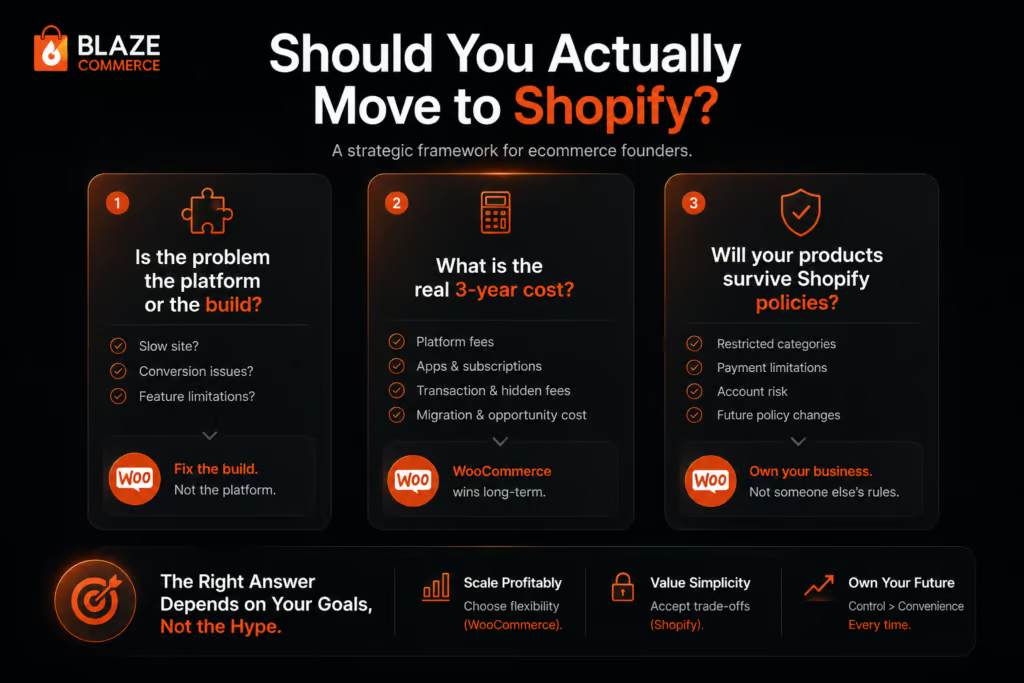
Answer these three with the real numbers and you don’t need an agency to tell you whether to move.
1. Is my actual problem the platform, or is it the build on the platform? If your WooCommerce store is slow, the platform isn’t the variable. Hosting, theme, plugin stack, and architecture are. Switching platforms moves the problem; it doesn’t resolve it.
2. What does my total Shopify cost look like over 3 years, all in? Platform fee plus apps plus transaction fees plus migration cost plus lost SEO revenue plus integration rebuilds. Compare against current WooCommerce cost plus a proper rebuild. The Shopify number is usually 2–3x the WooCommerce-done-right number.
3. Will my product category survive Shopify’s Acceptable Use Policy in twelve months? Read it. Not the summary. The policy. If your products sit anywhere near firearms, ammunition, CBD, hemp, cannabis, tobacco, vaping, supplements with health claims, or financial services, you are betting your business on a policy enforcement decision you don’t control.
If your answers are “build problem, Shopify is more expensive, my products are fine on Shopify” – go to Shopify. We’ll send you to a good Shopify agency.
If your answers are “build problem, Shopify is more expensive, my products are restricted” – you don’t need a migration. You need a rebuild.
Frequently asked questions
Is Shopify faster than WooCommerce?
Default Shopify is faster than default WooCommerce. Optimized WooCommerce on premium hosting is faster than Shopify can be. Optimized Shopify rarely achieves sub-1.5s LCP due to mandatory baseline scripts; optimized WooCommerce regularly achieves sub-500ms.
Will I lose SEO if I move to Shopify?
Yes, temporarily. A 5–10% traffic dip in the first month is normal even with clean execution. Full rankings recovery typically takes 3–6 months. Sloppy migrations cost more and recover slower.
Can Shopify handle firearms or CBD products?
Partially, and at significant cost. Shopify Payments prohibits firearms, holsters, ammunition, weapons, cannabis, and tobacco products outright. The Shopify platform itself bans specific firearm items – automatic weapons, high-capacity magazines, suppressors, bump stocks. Firearms accessories merchants can technically operate on Shopify with a third-party FFL-friendly payment gateway, but they lose access to Shopify Payments, Shop Pay, and Shopify Capital, and carry permanent acceptable-use-policy review risk. CBD requires attestation forms in the US and Shopify Plus plus a cannabis licence in Canada.
How much does Shopify Plus really cost?
Published at $2,300/month on a 3-year term. Real total monthly cost is $4,000–$10,000+ once you add apps, transaction fees, and the GMV-based pricing that kicks in above $800,000 monthly GMV.
How long does WooCommerce to Shopify migration take?
Most properly managed migrations take 6–12 weeks. Complex stores with B2B, multi-region, or custom logic take 4–6 months. Rushed migrations cost more in lost rankings than they save in time.
Can I customize Shopify checkout?
Only on Shopify Plus. Customizing your checkout experience on Shopify costs at least $2,300 per month. On WooCommerce, checkout customization is unlimited and free.
Does Shopify own my customer data?
In practice, yes. You can export it, but the platform controls access, format, and continuity. WooCommerce data lives in your database on hosting you own.
What about Shop Pay?
It is a real conversion lever for young DTC audiences. For B2B, regulated verticals, or older customer bases, the impact is smaller. If Shop Pay is your only reason to switch, the rest of the math probably doesn’t work. Shop Pay also only works with Shopify Payments, so merchants on third-party gateways don’t get access.
Is WooCommerce more secure than Shopify?
No. Shopify is more secure by default because the platform handles security centrally. WooCommerce can be made equally secure with proper hosting, but the responsibility is on you.
Can I use my existing payment processor on Shopify?
Yes, with a surcharge. On Plus, Shopify charges 0.2% per transaction on top of your gateway’s rate. On lower plans, the surcharge runs up to 2%.
What happens to my SEO if my product URLs change?
Without proper 301 redirect mapping, you lose them. Even with proper redirects, expect temporary ranking drops while Google re-crawls and re-evaluates.
Should I move to Shopify if my agency disappeared?
Get a new agency on WooCommerce before you decide. The “agency disappeared” problem is an agency problem, not a platform problem. Moving to Shopify because your developer ghosted is the most expensive way to solve an agency problem.
What if I’m doing under $20K/month – is the answer different?
Possibly. Under $20K monthly, total cost of ownership matters more than ceiling performance. Shopify on Basic might be the right call. Above $50K monthly, the math flips.
Should I go headless instead of switching to Shopify?
Probably not. Headless adds $70K–$100K+ in build cost and recurring infrastructure for a performance gain that proper WooCommerce optimization delivers at a third of the price. Headless makes sense at $3M+ annual revenue. Below that, the ROI math doesn’t pencil.
How do I know if I’m making the right decision?
Run the three questions in the diagnostic above. If you still aren’t sure, the $995 WooCommerce Revenue Audit shows you what’s happening on your current store and what a proper rebuild looks like – which is the information you need to make the decision, not Shopify’s marketing.
Your store is bleeding revenue. The question is which platform helps you stop the bleeding fastest.
For most operators we work with, Shopify is the more expensive way to solve a problem that doesn’t require replatforming. For the operators where Shopify is the right call, we’ll tell you that too – and we’ll send you to an agency we trust. What we won’t do is migrate a store that shouldn’t be migrated.
Run the diagnostic on your store
The $995 WooCommerce Revenue Audit returns specific findings – whether you should move to Shopify, stay on WooCommerce and optimize, or do nothing.
Start My Audit →Real data from your actual store, with a prioritized plan.
Campbell runs every audit
Founder · 10 years WooCommerce
An honest read on platform vs build
The audit reviews your store’s data and gives you the read on platform vs build – whether or not you go on to work with us. If Shopify is the right call, we’ll say so.
Start My Audit →No pitch – an assessment grounded in your numbers.