

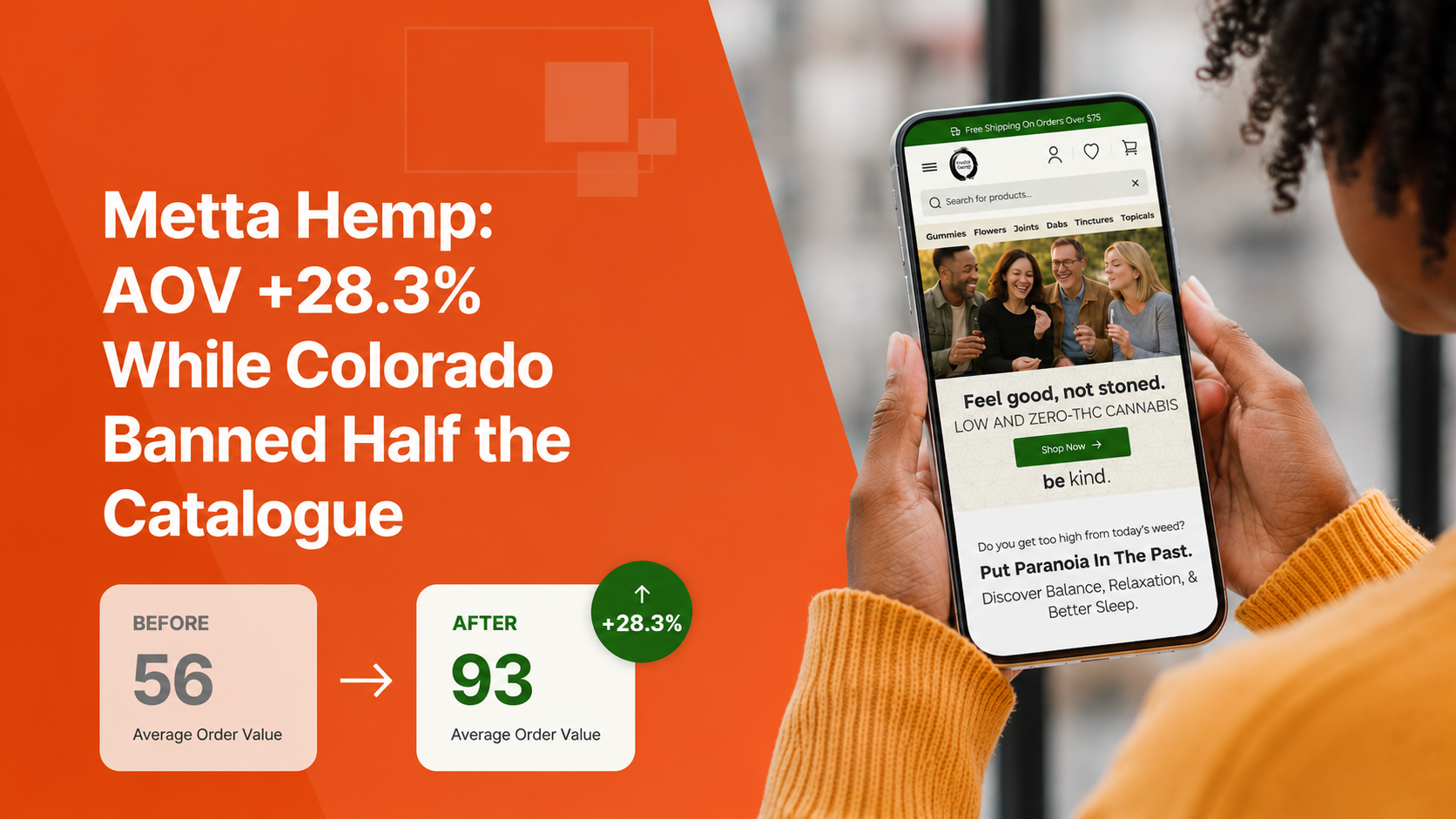
When Nick Vondra first reached out about mettahemp.com, the conversation was about conversion. The store had been stuck at the same monthly revenue for twelve months. Nick wanted to grow it by 50%.
The day before our solution call, Colorado’s Department of Health banned about half of Metta Hemp’s product range – roughly a third of the store’s revenue, gone overnight. Wholesale was already collapsing as more states restricted hemp. The site – already 70 to 80% of the business – was now the lifeline.
That changed the conversation. The conversion work we had pitched as growth became survival.
The TL;DR:
- Average order value up 28.3% – same customers, more spend per transaction, on the same traffic.
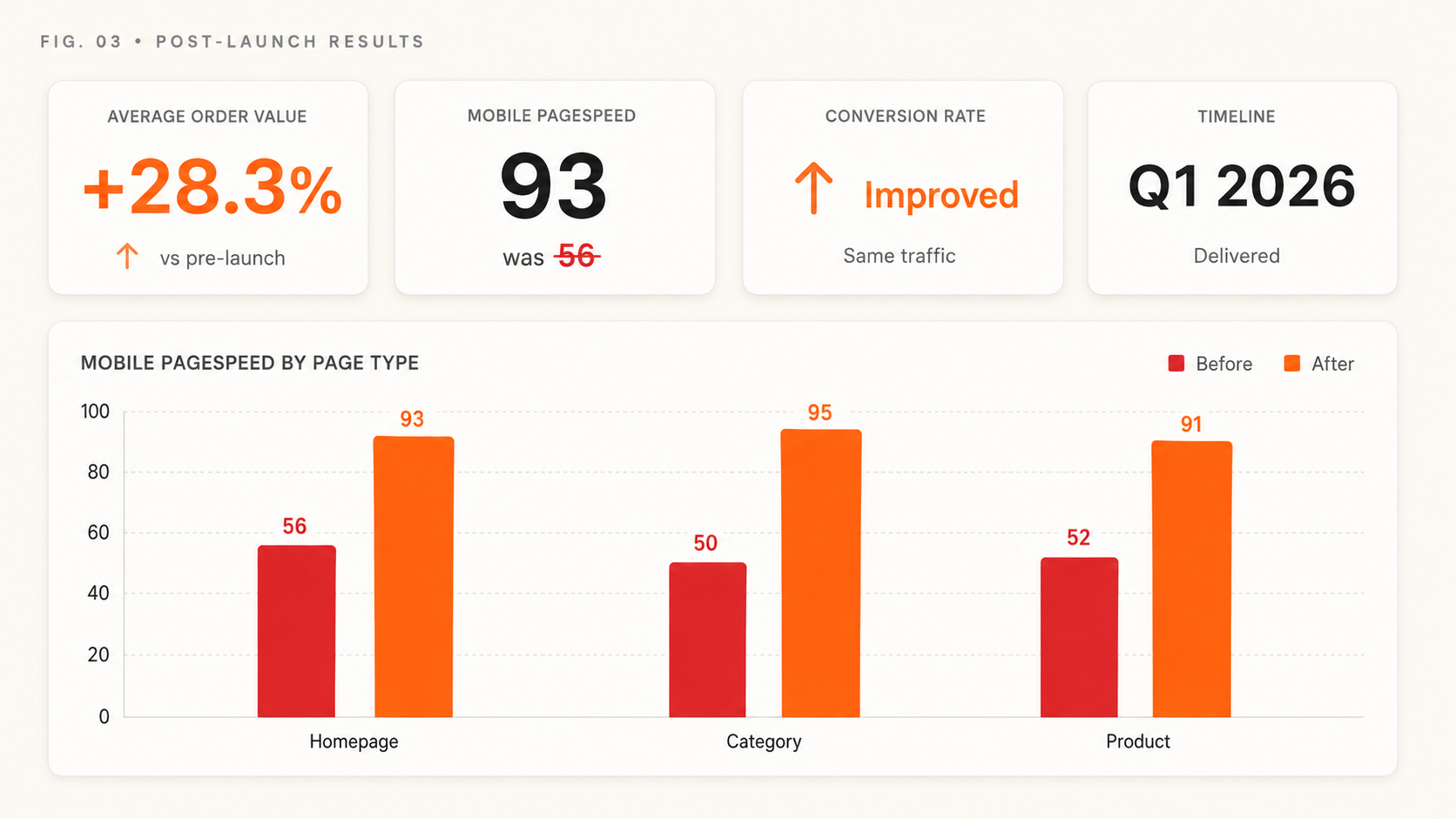
- Mobile PageSpeed 56 → 93+ across every page type. Homepage 93, category 95, product 91.
- First Contentful Paint 4.6s → under target. Largest Contentful Paint dropped from ~16s to within Google’s 2.5s threshold.
- No rebuild. The solo developer’s pitch was a $30K-$40K rebuild from scratch. We kept the SEO equity, the subscriptions, the plugin stack that runs the business – and resolved everything on top of it.
- Restricted vertical, no paid advertising. Instagram, Facebook, and Google all restrict hemp/CBD ads. Every visitor matters more when you can’t spend your way out of a conversion problem.
Delivered Q1 2026. Seven days, five touchpoints, one regulator-shaped emergency.
A note before we start: this case study gets into PageSpeed scores, UX failures, and the WooCommerce build underneath them. If that’s your world, the detail is all here. If it isn’t, the short version is this – Metta Hemp’s store was slower and harder to buy from than it needed to be, we resolved that on the same site they already had, and the same customers started spending more. Skip to the FAQ for what that means for your store.
When the regulator changed the conversation mid-deal
mettahemp.com is a Colorado-based CBD and hemp retailer. 73% mobile traffic. Subscription customers as a meaningful share of revenue. 40+ industry awards earned over years of running competitions in their category. The store ran on WooCommerce because Shopify has historically been hostile to cannabinoid sellers – the platform choice was a necessity, not a preference.
The brief looked straightforward when Nick first booked the call. Revenue had plateaued. Conversion was the constraint. Could we lift it.
Twenty-four hours before our solution call, the Colorado Department of Health published guidance that pulled around half of Metta Hemp’s catalog off the shelves. Roughly a third of monthly revenue, gone. Wholesale – already shrinking as more states tightened hemp regulations – was no longer a backstop. The website wasn’t 70 to 80% of the business anymore. It was the business.
That kind of news reshapes a project before it starts. The conversion lift Nick wanted as growth was now the difference between a viable Q2 and a bad one.
What was broken
Our diagnostic process looks at four layers – UX, performance, analytics, and the underlying WooCommerce build – developed across 11 years and hundreds of WooCommerce engagements. On Metta Hemp, the failures clustered in the performance underneath the site and the UX of the purchase journey, and the analytics showed exactly where the buyer was dropping out. For the UX layer we draw on the Baymard Institute’s ecommerce research alongside the patterns we’ve seen across hundreds of stores.
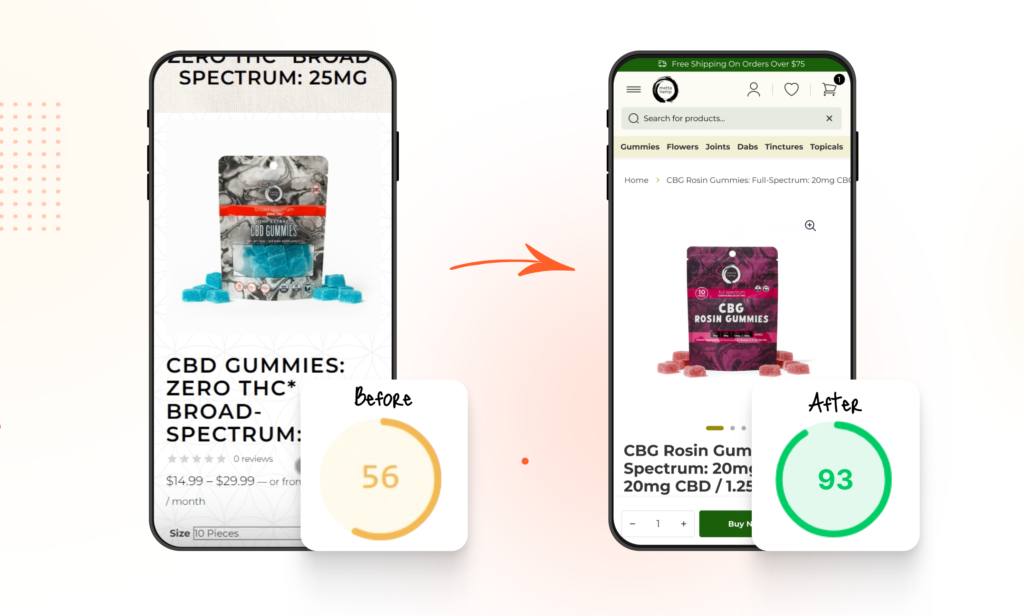
Performance. mettahemp.com scored 56/100 on mobile PageSpeed. First Contentful Paint was 4.6 seconds (Google’s target is 1.75s). Largest Contentful Paint was around 16 seconds (Google’s target is 2.5s).
Analytics. The data told the same story from the buyer’s side. Only 31% of visitors viewed a single product on the site. The ecommerce average is 50%. Top performers hit 70%. Mobile average order value was $20 lower than desktop – the mobile/desktop AOV gap alone represented roughly 10% of monthly revenue being left on the floor.
UX. 73% of traffic was mobile, and the product page rated poor across product discovery, the product page, and checkout. On-site search wasn’t present at all – a third of ecommerce visitors prefer search, and search users are twice as likely to buy.
WooCommerce build. A page-builder-heavy theme and an unreviewed plugin stack carried most of the performance weight, and out-of-the-box WooCommerce defaults left the product discovery, product page, and checkout journeys weaker than they needed to be.
Then there’s a constraint that frames everything else: paid advertising is not available to Metta Hemp. Instagram, Facebook, and Google all restrict hemp and CBD advertising. Growth comes from organic traffic, referrals, and subscriptions. Every visitor matters more than it would for a brand that can spend its way out of a conversion problem.
Why this hadn’t been solved
Nick had been working with the same solo developer since 2017. Competent, low-retainer, but no design or analytics capability. When Nick raised the speed problem, the developer’s recommendation was to rebuild from scratch for $30,000 to $40,000. Nick rejected it and paid for a homepage refresh instead.
Two years earlier, an SEO consultant had grown the store’s revenue by 75% by overhauling search optimization. The work hit its number – but the design changes optimized for ranking, not for buying. Nick said it directly on our discovery call: “I know there’s a more professional interface that could exist that doesn’t.”
That’s the position a lot of WooCommerce store owners find themselves in. The developer can’t see another path, so the only paths offered are rebuild or do nothing. We don’t rebuild. We work with what’s already there – the SEO equity, the plugin stack that runs the business, the subscriptions, the customer history – and resolve the performance and UX problems sitting on top of it.
We’ll show you exactly where your store loses revenue.
We audit your store across UX, performance, and conversion, then show you the specific issues costing you orders – each one measured against revenue impact. You get a prioritised list of what’s losing money and what it’s worth to resolve.
- ✓239-point Baymard UX audit
- ✓Core Web Vitals + LCP + CLS benchmark
- ✓SemRush health benchmark
Every finding comes with the revenue it’s costing you and the lift from resolving it. You decide what’s worth doing.
What we did
We don’t do rebuilds. In 11 years, we’ve never told a client to start over. Metta Hemp’s site after we shipped was the same site they came to us with – same URL, same content, same orders, same customer data. What changed was the theme, the failing UX across product discovery, the product page, and checkout, the plugin stack, and the performance configuration underneath. Same store, working properly.
Before we wrote a line of code, we made a specific prediction: closing the mobile/desktop AOV gap alone would recover roughly 10% of monthly revenue. Doubling product view rate from 28-35% to closer to 70% would add another 50 to 100 orders per month from the same traffic Metta Hemp already had.
That prediction shaped the work.
Theme and architecture
We replaced the theme with a WordPress block-native theme. Block themes load about 40% faster than the page-builder-driven themes that dominated the WooCommerce space five years ago. Pages built with Gutenberg natively, without bolted-on builders, render faster and stay faster.
Product discovery
Added typo-tolerant predictive search to a site that had none. Rebuilt category pages to eliminate the three-column-to-one-column shift happening mid-load on mobile. Resolved product list and filtering across both viewports.
Product page
Single product title instead of duplicated. Solid background under body text instead of the visual effect that was making copy hard to read. Three product images per SKU as the new minimum. Subscriptions defaulted to recurring instead of one-time. Sticky add-to-cart on mobile so the purchase decision was always one tap away. The 40+ award badges Nick had earned from industry competitions – previously invisible on the page where they mattered most – surfaced as social proof at the point of purchase decision. Reviews tab hidden when empty, no more zero-state planting doubt.
Plugin stack
Removed plugins that slowed the site without adding revenue. Kept the subscriptions plugin, the SEO content, and everything that ran the business. Nothing got broken in the process.
Performance
Image delivery, render-blocking resources, database tuning, caching. The site moved onto edge-network hosting – copies of the site on servers around the world, so a visitor anywhere in the US gets the page from a nearby server instead of one round-trip across a continent.
Results: AOV up 28.3% on the same traffic
Two outcomes, in order of importance.
Conversion improved. Visitors who hit a faster, more navigable site converted at a higher rate than they did before.
The more notable outcome: average order value climbed 28.3%. Same customers, more spend per transaction.
This is a pattern we see consistently across clients. When a site loads in half a second and visitors can find what they’re looking for, behavior changes. They stay longer. They look at more products. They find things they didn’t know they were looking for and add them to the cart. A slow, hard-to-navigate site forces a transactional mindset – buy what brought you there and leave. A fast, easy-to-navigate site invites exploration. Metta Hemp’s AOV lift is the quantitative version of that shift.
Mobile PageSpeed. 56 → 93 on the homepage, 95 on category pages, 91 on product pages. First Contentful Paint and Largest Contentful Paint both moved inside Google’s targets across every page type.
“I prefer to let you do what you do, and I do what I’m good at, and I’ll stay out of your way, and you just tell me the things I need to know.”
Nick Vondra, Founder, Metta Hemp
That’s the trust earned across seven days, five touchpoints, and a regulator-shaped emergency that changed the stakes mid-conversation.
If your WooCommerce store looks like this
If your store is in a restricted vertical – CBD, hemp, firearms, tactical – and paid advertising is unavailable to you, every visitor matters more than it would for a brand that can spend its way out of a conversion problem.
A PageSpeed score in the 50s, a mobile/desktop AOV gap, and product view rates below 50% are leaving meaningful revenue on the floor every day they sit unaddressed. You don’t have to rebuild your site to address them. Most of the time, you shouldn’t.
“The site functions much better than it did before. It has the finishing touches that makes it look like a high end ecommerce site.”
Nick Vondra, Founder, Metta Hemp
Frequently asked questions
Do you work with CBD, hemp, or firearms WooCommerce stores?
Yes – restricted verticals are one of our core focus areas. Tier 1 verticals include CBD, hemp, firearms, and tactical. These businesses are underserved by mainstream agencies and have historically been hostile territory on Shopify. WooCommerce is the platform of necessity, and we specialize in making it perform.
Can you optimize a WooCommerce store without rebuilding it?
Almost always. We preserve the SEO equity, the plugin stack that runs the business, the subscriptions, and the customer history – and resolve the performance and UX problems sitting on top of them. Metta Hemp’s existing developer had recommended scrapping the site and starting over for $30K-$40K. We declined that path, kept the same store, and delivered AOV +28.3% and PageSpeed 56 → 93+.
What is a good mobile PageSpeed score for a WooCommerce store?
90+ is the target. Most WooCommerce stores score in the 40-65 range on mobile, which translates to First Contentful Paint of 3-5 seconds and Largest Contentful Paint of 10-16 seconds. Google’s targets are 1.75s and 2.5s. Anything below 80 on mobile is leaving conversion revenue on the floor every day it sits unaddressed.
Why is mobile PageSpeed more important than desktop?
70-80% of WooCommerce store traffic is mobile, and mobile typically converts at roughly half the rate of desktop – the mobile/desktop AOV gap on Metta Hemp alone represented about 10% of monthly revenue. Most stores optimize desktop and assume mobile follows. It doesn’t.
Why did Metta Hemp’s average order value go up after the optimization?
When a site loads in half a second and visitors can find what they’re looking for, behavior changes. They stay longer, look at more products, and find things they didn’t know they were looking for. A slow site forces a transactional mindset – buy what brought you there and leave. A fast site invites exploration. AOV is the quantitative version of that shift.
How long does a WooCommerce performance optimization take?
Most projects deliver in 4-8 weeks depending on store complexity, plugin count, and scope of UX work. Metta Hemp was delivered Q1 2026 across seven days of intensive scoping and five touchpoint calls. Faster projects are possible when the store is well-organized and the decision maker is engaged.
How do you assess WooCommerce UX?
UX is one of four layers in our diagnostic process, alongside performance, analytics, and the WooCommerce build. For the UX layer we draw on the Baymard Institute’s ecommerce research as a source, combined with the patterns we’ve seen across 11 years and hundreds of WooCommerce engagements. We assess product discovery, the product page, cart, and checkout – and on most stores the “adequate” surface masks several high-priority issues costing real revenue.
My developer says my WooCommerce store needs a rebuild. Are they right?
Almost never. A rebuild typically costs $30K-$50K, takes 3-6 months, breaks SEO equity, and frequently introduces new performance and UX problems. The developer often recommends it because rebuilding is the only solution they know – not because it’s the right one. Most WooCommerce performance and UX issues can be resolved by optimizing what’s already there.
Can paid advertising resolve a WooCommerce conversion problem?
For restricted verticals like CBD, hemp, firearms, and cannabis it’s not an option – Instagram, Facebook, and Google all restrict the category. Even for unrestricted stores, spending on ads to push traffic at a broken product page buys more abandonments. Resolve the conversion problem first, then scale traffic.
What does an edge-network hosting setup do for WooCommerce performance?
Edge-network hosting stores copies of your site on servers around the world. A visitor in California gets the page from a server in California; a visitor in New York gets it from a server in New York. Compared to a single-server setup serving every request from one location, edge networks typically cut Time to First Byte by 40-60% and improve Largest Contentful Paint significantly – especially for distributed US audiences.
The pattern: same traffic, more revenue, no rebuild
Metta Hemp didn’t get more traffic. They got the same visitors landing on a faster, more navigable site – and spending 28.3% more per transaction. That outcome wasn’t a fluke. It’s the pattern we see across stores in restricted verticals, on suboptimal hosting, with developer relationships that defaulted to “rebuild or do nothing.”
The work isn’t glamorous. Replace the theme. Add real search. Resolve the mobile product page failures. Surface the social proof that was already there but invisible. Move onto edge hosting. Strip the plugins that cost performance without contributing revenue. Done in weeks, not quarters. No SEO equity lost. No customer history broken.
If your developer’s only answer is a rebuild, get a second opinion before you sign the check.
Get my Revenue Recovery Audit
We score your store against the same 245-point Baymard standard we run on every audit, benchmark your mobile PageSpeed, and send the findings within 7 days – each gap ranked by revenue impact.
Get My Revenue Audit →Every gap is tied to a dollar figure and a priority.
Talk directly with Campbell
Founder · 11 years WooCommerce
Schedule a strategy call
30 minutes with Campbell on your UX and performance challenges with WooCommerce – especially if you’re in a restricted vertical where paid ads aren’t an option.
Schedule My Strategy Call →30 minutes. No pitch – an honest assessment of where you stand.