


Generally, the businesses we work with have hit a ceiling with their online sales and their current developers. They’re looking for a partner to take them to the next level. Porselli Dancewear was different – they were losing ground to competitors and bleeding revenue from problems their £100/hour agency couldn’t (or wouldn’t) resolve.
This article is part of our WooCommerce Performance Optimisation series. For the complete guide covering why stores are slow and how to address it, start there.
When customers reported their checkout was hanging during payment confirmation – leaving them uncertain if orders had even processed – Stuart knew they’d hit rock bottom. A leak that size was quietly draining a meaningful share of every month’s revenue, and nobody could see where it was going.
A note before we start: this case study gets into checkout failures, UX issues, performance, and the WooCommerce build underneath them. If that’s your world, the detail is all here. If it isn’t, the short version is simple – Porselli’s store was harder and less reliable to buy from than its competitors’, we resolved that on the same site they already had, and the same customers started completing more orders. Skip to the FAQ for what that means for your store.
When Premium Service Meets Broken Technology
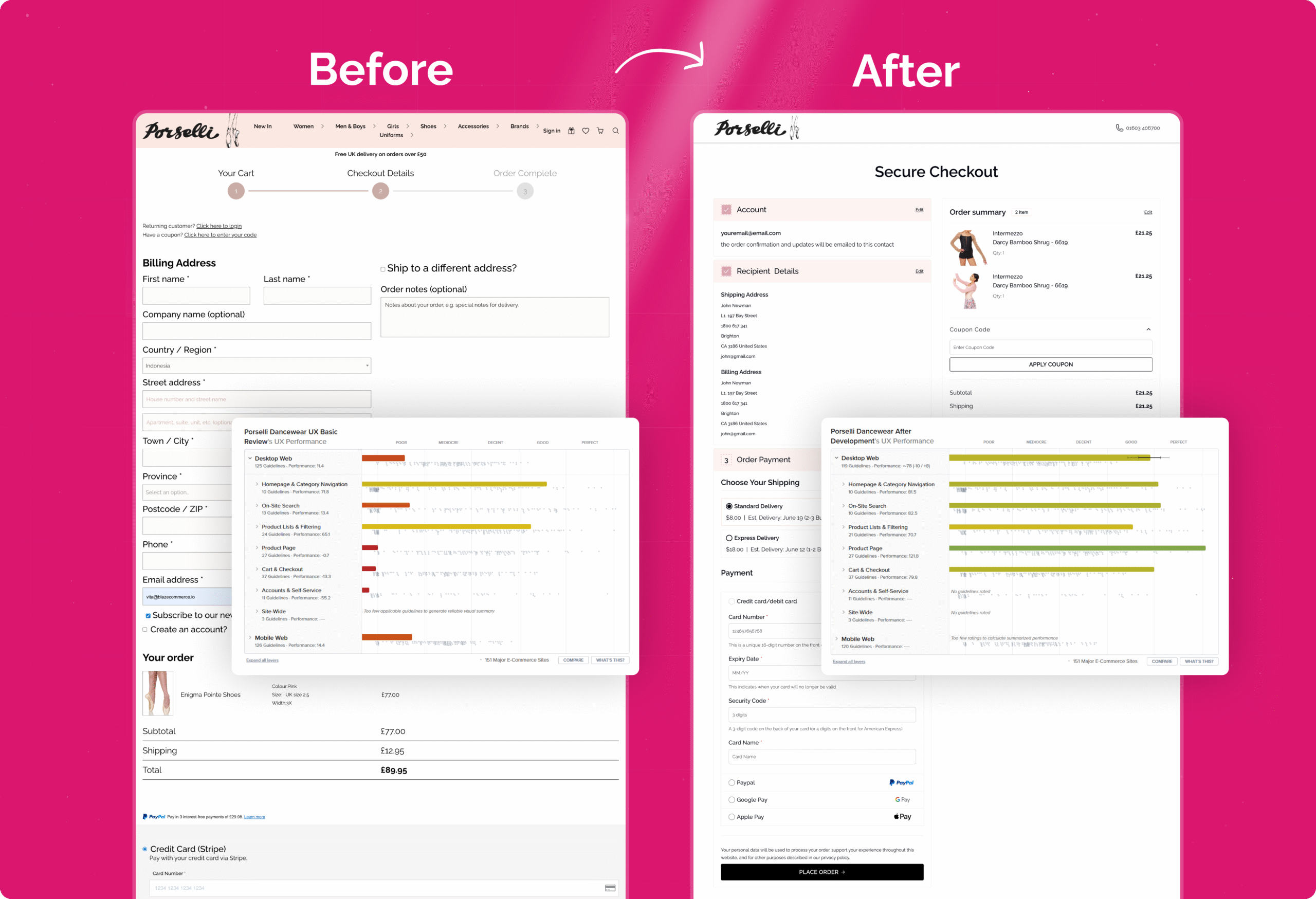
Porselli Dancewear should have been thriving. With 16,000+ product variations, they’re one of the UK’s most comprehensive dancewear retailers. Their customer service is exceptional – they respond to issues within hours, personally call about order problems, and maintain a 4.1-star Google rating despite inheriting terrible reviews from the previous owner.
But none of that mattered when the checkout didn’t work.
“It undermines confidence in the website,” Stuart told us. With revenue down 20% year-over-year and their major supplier Capezio now selling direct to consumers at lower prices, every lost conversion hurt. Their Google Ads ROAS had crashed from a profitable 5-8x down to barely 3x – a clear sign of deeper conversion issues.
The family business Gina had inherited – reluctantly – from her mother was 9 months from closure if nothing changed.
We’ll show you exactly where your store loses revenue.
We audit your store across UX, performance, and conversion, then show you the specific issues costing you orders – each one measured against revenue impact. You get a prioritised list of what’s losing money and what it’s worth to resolve.
- ✓239-point Baymard UX audit
- ✓Core Web Vitals + LCP + CLS benchmark
- ✓SemRush health benchmark
Every finding comes with the revenue it’s costing you and the lift from resolving it. You decide what’s worth doing.
The Developer Lock-In Trap
The most frustrating part? Stuart knew exactly what needed resolving. As a former banking executive who’d spent recent years consulting in payments, he understood user experience. But their current agency had them trapped:
- No developer access to their own site
- £100/hour for any changes (plus VAT)
- Hosted on shared AWS servers they couldn’t migrate from
- Support contract prepaid through May with no refunds
“They don’t give a shit,” Stuart said bluntly. “They’re happy to collect their monthly fee to ‘optimize’ our Google Ads without any return.”
Every other agency kept pushing the same solution: “Move to Shopify.” But Stuart understood what many don’t – owning your infrastructure matters. “I want to own my business, not rent it from a platform.”
What Was Broken: Four Layers, One Diagnostic Process
We don’t audit a store through a single lens. Across 11 years and hundreds of WooCommerce engagements, we’ve learned that revenue leaks like Porselli’s live in the overlap between four diagnostic layers: UX, performance, analytics, and the WooCommerce build itself. When we evaluated Porselli’s site, every layer had problems their expensive agency had overlooked for years.
UX layer – the checkout disaster: Multiple friction points causing abandonment:
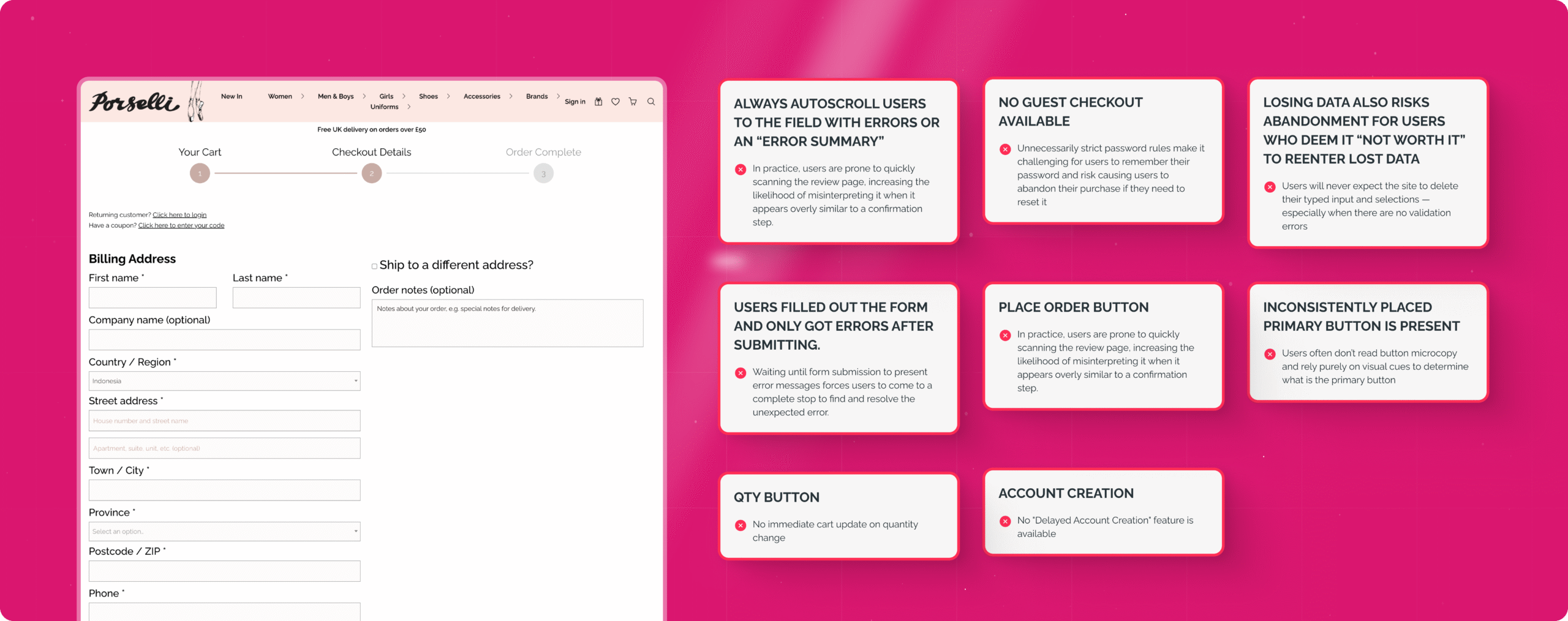
- Hanging payment confirmations leaving customers in limbo
- Unnecessary required fields varying by region
- No progress indicators or trust signals
- Missing express payment options
More UX failures uncovered: Our UX evaluation – informed by Baymard Institute research alongside pattern recognition across hundreds of WooCommerce stores – revealed:
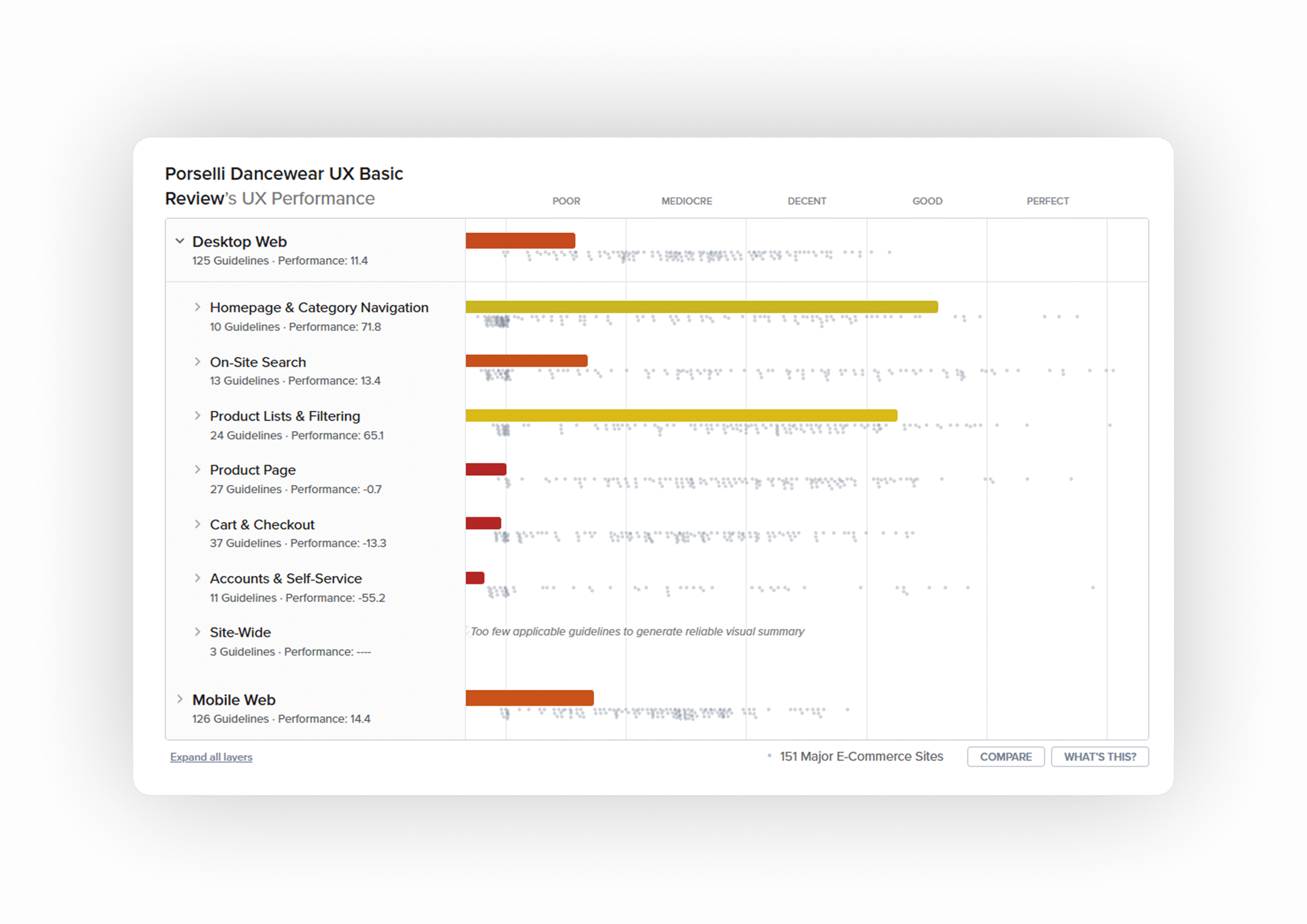
- Product pages missing critical trust elements (zero reviews after years online)
- Search functionality failing on misspellings (“most people can’t spell”)
- Category navigation requiring excessive clicks to find products
- Mobile experience issues despite significant mobile traffic
Performance and analytics layers: The store was hosted on shared infrastructure with no developer access, and the hanging checkout was invisible in their reporting – their analytics never showed when customers refreshed during payment confirmation, so the leak ran silently. Read against the traffic, the data told a consistent story: customers were arriving, struggling, and leaving.
WooCommerce build layer – complex requirements ignored:
- Need for differential pricing (online vs in-store)
- Returns process from the 1990s (literal paper forms)
- No integration between online and physical store inventory
- Multi-supplier complexity with varying margin structures
But here’s what made us different: we understood the constraints. Stuart needed someone who could work within his reality – limited budget, existing infrastructure, prepaid hosting contract, and a ticking clock. Our custom development expertise meant we could work with what they had.
What We Did: The Pragmatic Transformation
We don’t do rebuilds. In 11 years, we’ve never told a client to start over. Porselli’s site after we shipped was the same site they came to us with – same URL, same content, same orders, same customer data. What changed was the failing checkout, the broken search, the missing trust signals, and the infrastructure trapping them. Same store, working properly. We surgically resolved what was killing conversions while working within their constraints:
Checkout Overhaul
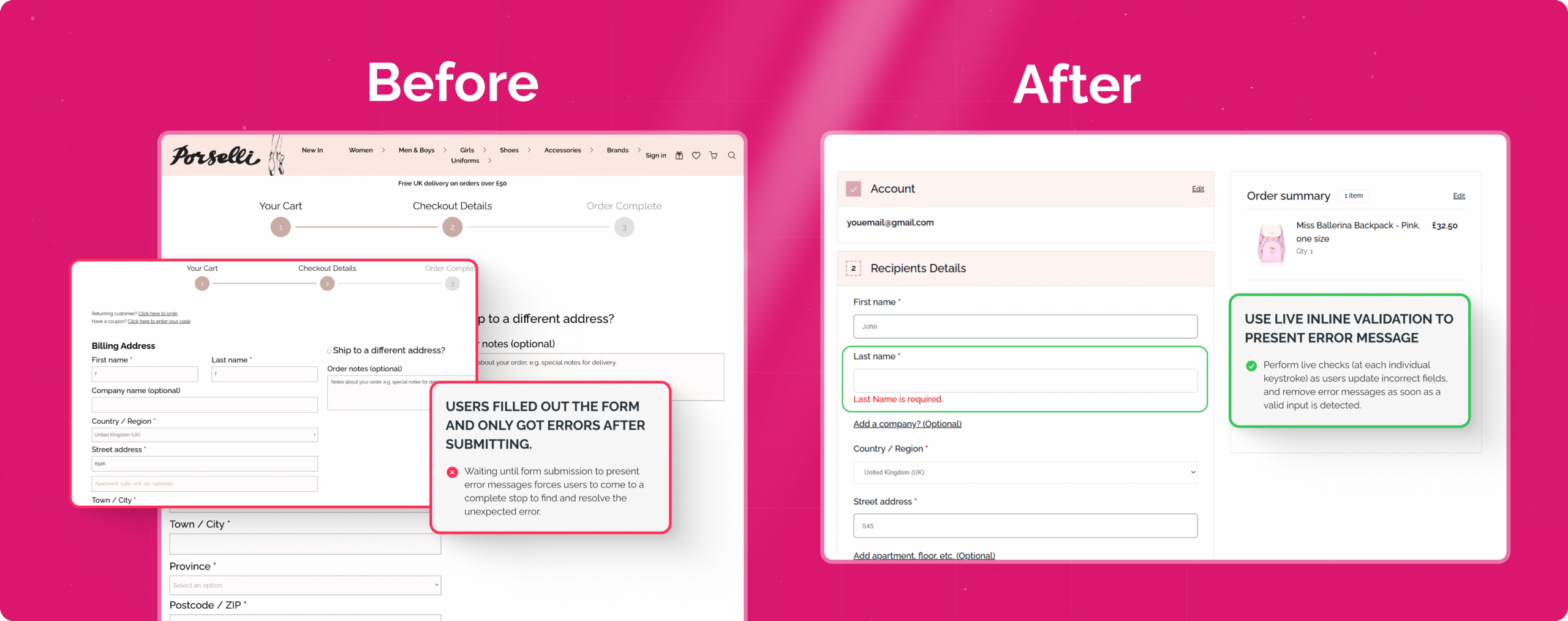
- Eliminated hanging payment states with proper error handling
- Implemented smart field requirements by region
- Added clear progress indicators and trust signals
- Integrated express payment options for returning customers
Search That Works:
- Typo tolerance for the reality that dancers can’t spell “character shoes”
- Instant results with visual feedback
- Category integration for browsing 16,000+ variations
- Intelligent filtering that helps discovery
Trust Restored:
- Structured data for Google’s rich snippets
- Review system implementation (finally)
- Proper breadcrumbs and navigation hierarchy
- Mobile-first optimisation for product browsing
Technical Liberation:
- Negotiated developer access with their current host
- Implemented headless architecture for sub-second loads
- Maintained all existing WooCommerce workflows
- Created pathway to escape vendor lock-in
Early Indicators of Recovery
One month post-launch, the metrics tell an encouraging story:
Engagement Transformation:
- Engaged sessions per active user: Up 10.34%
- Average engagement time: Up 77.78% (from 1m 09s to 2m 04s)
- Conversion rate up by 31.4%: sales and average order values have significantly increased
These aren’t vanity metrics. When users spend nearly twice as long on your site, they’re finding what they need. When engagement jumps double digits, friction has been removed.
The checkout that was breaking on customers mid-payment? Now completes reliably. The products that were impossible to find? Now surfaced through intelligent search. The trust that was eroding? Recovering through every interaction.
While it’s too early for final revenue numbers, Stuart’s already seeing what matters: customers completing purchases instead of calling to complain.
The Specialist Difference
Most agencies would have pushed Porselli toward an expensive ground-up reconstruction or platform migration. As WooCommerce specialists since 2010, we knew better. We understood:
- The complexity of 16,000+ SKUs with variant pricing
- The challenge of competing against your own suppliers
- The reality of inherited technical debt and vendor lock-in
- The importance of maintaining existing workflows during crisis
This wasn’t about transformation for transformation’s sake. It was about surgical work that stopped the bleeding while positioning for future growth through our maintenance and support services.
“I needed someone who knows what they’re doing and is good value,” Stuart explained. “Not another agency charging £100/hour to tell me nothing can be done.”
Beyond Survival: Building for Growth
Porselli Dancewear faced a choice: accept decline as inevitable or fight back with the right technical partner. One month in, the early metrics suggest they made the right choice.
But this story isn’t only about crisis recovery. The checkout problems eroding Porselli’s business exist in varying degrees across most WooCommerce stores. The difference? Some resolve them before they become critical.
Every successful store eventually hits a ceiling – whether it’s technical limitations, developer constraints, or user experience debt. The question isn’t whether you have these problems. It’s whether you’ll address them proactively or wait until they threaten your survival.
How Much Is Your Checkout Quietly Costing You?
The hanging checkout draining Porselli’s business could be happening to 5% of your orders right now – and at that rate it can quietly siphon a meaningful share of monthly revenue before anyone notices. Your analytics won’t show when customers refresh during payment confirmation. Your current developer might not care enough to investigate.
Whether you’re scaling successfully or fighting to survive, checkout friction is universal. The only variable is how much of your revenue it’s quietly taking.
Get Your Free UX Evaluation to discover what checkout problems are hiding in your analytics – and what proportion of revenue they’re costing you.
Ready to escape developer lock-in and resolve the problems holding you back? Schedule a Strategy Call to discuss your specific situation.
Frequently asked questions
What was wrong with Porselli’s checkout?
The checkout was hanging during payment confirmation, leaving customers unsure whether their order had gone through. Many refreshed or abandoned, and the failure never surfaced in the store’s analytics. Combined with unnecessary required fields, no progress indicators, and missing express payment options, it was quietly draining a meaningful share of monthly revenue. We eliminated the hanging payment states with proper error handling and streamlined the rest of the flow.
Did you have to move Porselli off WooCommerce or onto a new platform?
No. In 11 years, we’ve never told a client to start over, and we don’t push clients onto Shopify. Every other agency had told Stuart to move to Shopify. Porselli stayed on WooCommerce, on the same URL, with the same orders and customer data intact. We resolved the failures on the site they already had and negotiated developer access so they were no longer locked out of their own store.
How do you find problems a £100/hour agency missed for years?
We evaluate every store across four diagnostic layers – UX, performance, analytics, and the WooCommerce build – instead of through a single lens. That integrated process, built from 11 years and hundreds of WooCommerce engagements, surfaces revenue leaks that live in the overlap between layers. A hanging checkout invisible in analytics is exactly the kind of failure a generalist agency on an hourly contract has no incentive to chase down.
How quickly did the results show up?
Within one month of launch, conversion rate was up 31.4%, average engagement time was up 77.78%, and engaged sessions per active user were up 10.34%. Final revenue figures take longer to settle, but the leading indicators moved fast because the work targeted the specific friction stopping customers from completing purchases.
My store has thousands of variations and complex pricing. Can you handle that?
Yes. Porselli runs 16,000+ product variations with differential pricing between online and in-store, multi-supplier margins, and inherited technical debt. We’ve worked with that level of complexity across hundreds of WooCommerce engagements. The integrated build is the point – search, checkout, pricing, and inventory all have to hold together for the store to perform.
How do I find out what my own checkout is costing me?
Start with a UX evaluation. It surfaces the checkout, search, and performance failures hiding in your analytics, scored by their impact on revenue, so you can see what proportion of orders is leaking before you commit to anything.
About This Project
Client: Porselli Dancewear
Industry: Dance Apparel & Accessories
Location: Norwich, UK
Challenge: 20% revenue decline, checkout failures, developer lock-in
Inventory: 16,000+ product variations
Key Improvements (Month 1):
- 10.34% increase in engaged sessions per user
- 77.78% increase in average engagement time
- Checkout reliability restored
- Search functionality with typo tolerance
- Trust signals and review system implemented
View More Case Studies | Learn About Our Services | Get Your Performance Report
Get my Revenue Recovery Audit
We score your store against the same 245-point Baymard standard we run on every audit, benchmark your mobile PageSpeed, and send the findings within 7 days – each gap ranked by revenue impact.
Get My Revenue Audit →Every gap is tied to a dollar figure and a priority.
Talk directly with Campbell
Founder · 11 years WooCommerce
Schedule a strategy call
30 minutes with Campbell on your UX and performance challenges with WooCommerce – especially if you’re in a restricted vertical where paid ads aren’t an option.
Schedule My Strategy Call →30 minutes. No pitch – an honest assessment of where you stand.