

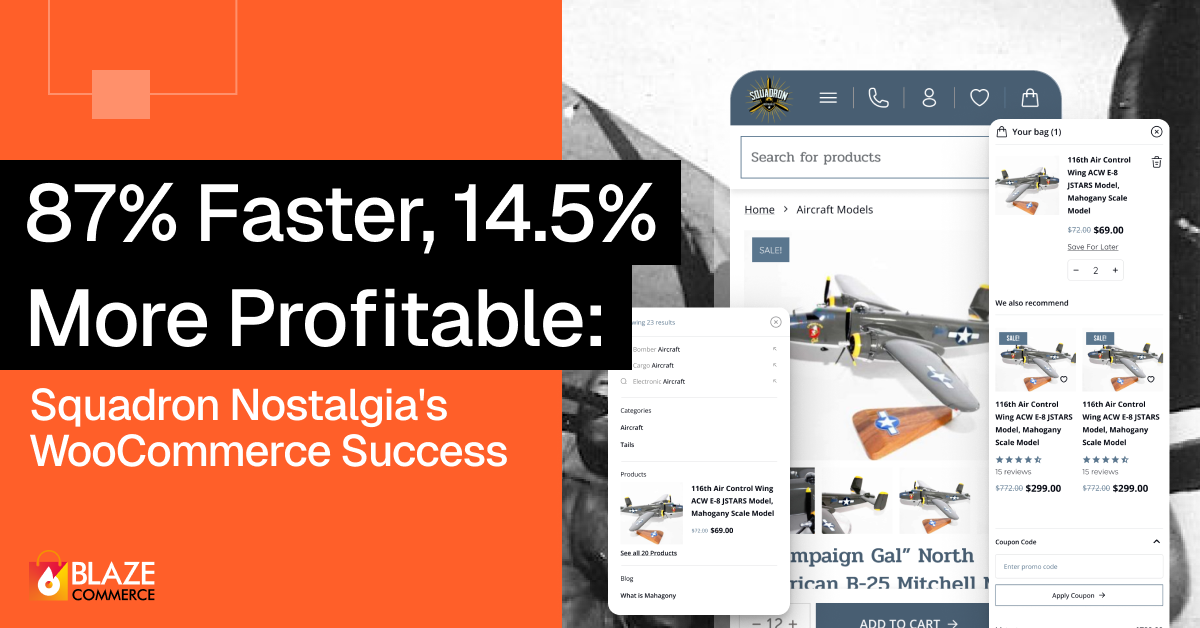
Client Context & Challenge
Squadron Nostalgia, a high-volume US store, serves a passionate community of military veterans and aviation enthusiasts with over 9,000 handcrafted models and patches. Founded by former naval aviator Nathan Rocklein, the business had grown beyond what his self-built WooCommerce site could handle.
This article is part of our WooCommerce Performance Optimization series. For the complete guide covering why stores are slow and how to resolve it, start there.
The Cost of Status Quo:
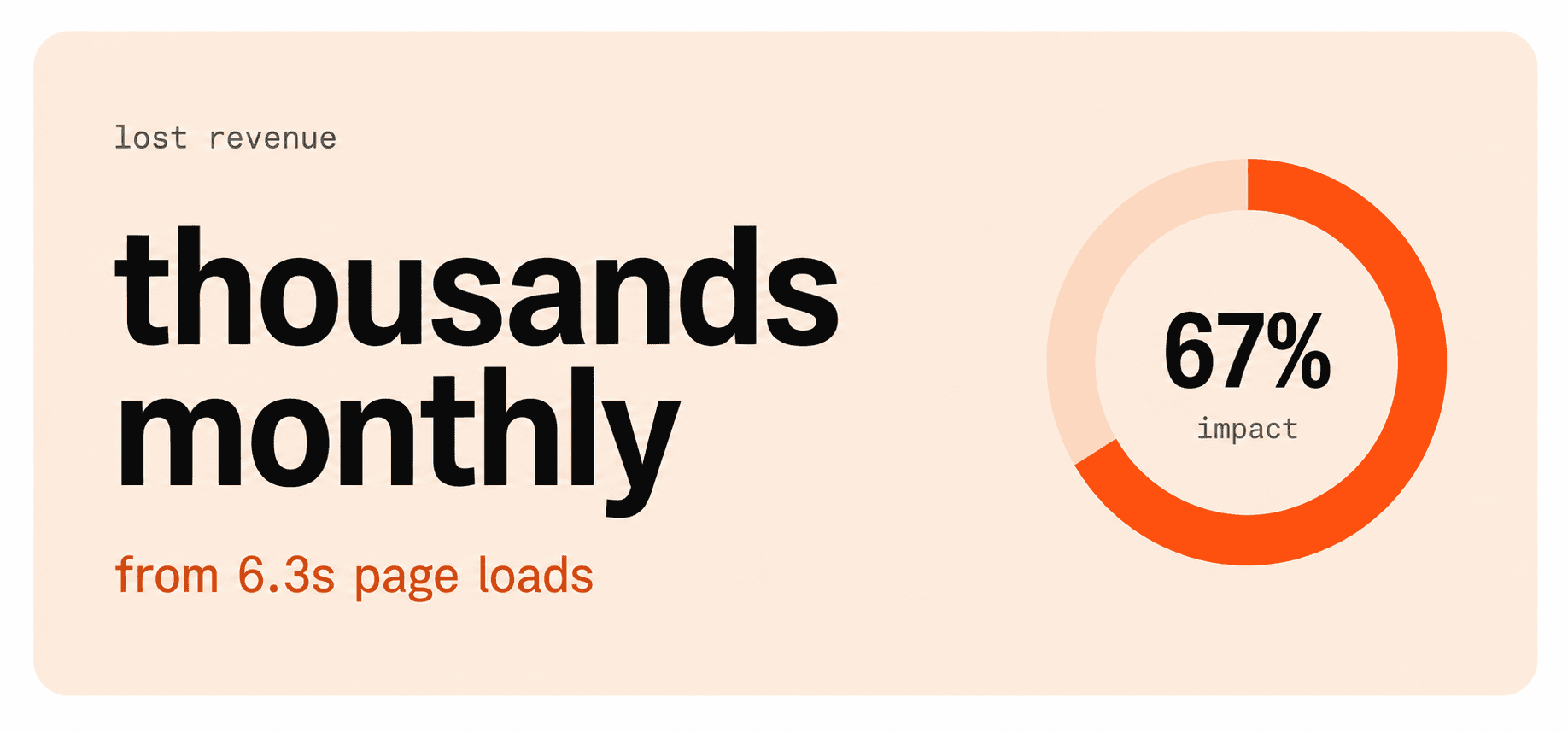
Nathan knew he was losing a meaningful share of monthly revenue from performance issues alone. With 6.3 second page loads and the Walmart study showing 67% conversion drops per second of delay, the math was devastating. But beyond the numbers, customers were complaining directly: “I don’t want to wait a couple seconds.”
Technical Debt After 10 Years:
- 80 active plugins creating constant conflicts (“there’s always a gremlin somewhere”)
- Site crashes when bulk editing more than 50 products
- 1.2 million image files from failed optimization attempts
- Hacking incidents requiring emergency interventions
- Can’t update basic pages due to Elementor conflicts
As Nathan told us: “I’m tired of things breaking… When I first started the website, I did a bunch of customization stuff. And then I was like, I can’t keep up with this stuff.”
A note before we start: this case study gets into PageSpeed scores, UX failures, and the WooCommerce build underneath them. If that’s your world, the detail is all here. If it isn’t, the short version is simple – we moved Squadron Nostalgia to a headless build that runs 87% faster and is 14.5% more profitable, without the constant breakage of the old site. Skip to the FAQ for what that means for your store.
What Was Broken
Our diagnostic process looks at four layers – UX, performance, analytics, and the underlying WooCommerce build – developed across 11 years and hundreds of WooCommerce engagements. On Squadron Nostalgia, the failures clustered in the WooCommerce build and the performance underneath it, which in turn dragged down the UX of the purchase journey.
- WooCommerce build: 80 active plugins layered over a decade of customization, crashing on bulk edits, breaking on routine page updates, and exposed to repeated hacking incidents.
- Performance: 6.3-second page loads against a half-second target, with 1.2 million orphaned image files from failed optimization attempts weighing the site down.
- UX: a 9,000-product catalog with navigation, search, and filtering that left shoppers unable to find what they came for. Against the Baymard Institute’s ecommerce research – the standard we draw on for the UX layer alongside our own pattern recognition across hundreds of stores – the mobile experience rated poor across the board.
- Analytics: the data showed mobile shoppers disengaging and high-intent paid traffic landing on pages too slow to convert.
What We Did
We don’t do rebuilds. In 11 years, we’ve never told a client to start over. Squadron Nostalgia kept the same store – same URL, same content, same orders, same customer data, and the same WooCommerce admin Nathan already knew. What changed was the frontend the shopper sees.
For Squadron Nostalgia, that frontend was a headless build. Headless was the right call here for one reason: this is a high-volume store – well above the roughly $3M/year line where a headless frontend earns its keep – with a 9,000-product catalog straining the architecture. For most stores below that line, we’d reach the same half-second page loads through WooCommerce optimization instead, at a fraction of the cost. If you’re weighing the decision, our when not to go headless with WooCommerce guide walks through exactly where that line sits, and a WooCommerce Revenue Audit tells you straight which side of it your store is on.
The work, across the four layers:
- Full headless architecture using React/Next.js (the same approach behind Netflix, Nike, and Walmart frontends), served from a global CDN with 90 edge locations via Vercel.
- Reduced the plugin load from 80 to 60 by moving capability into the architecture, and resolved the bulk-edit crashes, the Elementor page-update conflicts, and the security exposure.
- Restructured product discovery for a 9,000-product catalog: a mega menu, onsite search built natively into the frontend (resolving the failing onsite search UX), and filtering and categorization built around how this audience searches, including NATO-standard taxonomy.
- Preserved every critical integration: accounting, CRM, shipping providers, 3PL, and payment gateways all kept working as before.
Accessibility
Accessibility is part of the UX layer, not an afterthought. Building the frontend on React/Next.js let us ship semantic, keyboard-navigable markup with proper heading structure, descriptive alt text across the catalog, visible focus states, and color contrast that meets WCAG 2.1 AA. For a store whose customers span every age and ability across the veteran and aviation community, the same work that makes the site fast for everyone also makes it usable for everyone – including shoppers using screen readers or navigating without a mouse.

Implementation Process: Partnership Not Project
Unlike typical “launch and disappear” approaches, we delivered a true partnership. Learn more about our process.
Collaborative Timeline:
- Several hundred hours including comprehensive design phase
- Weekly check-ins throughout implementation
- Extended timeline to ensure perfection (Nathan: “Timeline was longer than expected but all worked out”)
- Flexible payment structure matching cash flow needs
Zero Workflow Disruption:
Nathan’s biggest concern: “How long do changes take to show?” When we demonstrated changes sync within seconds, not minutes or hours, his concern was resolved. He continues managing everything in WooCommerce exactly as before – products, orders, fulfillment, all unchanged.
Results & Impact: Measurable Transformation
Performance Revolution:
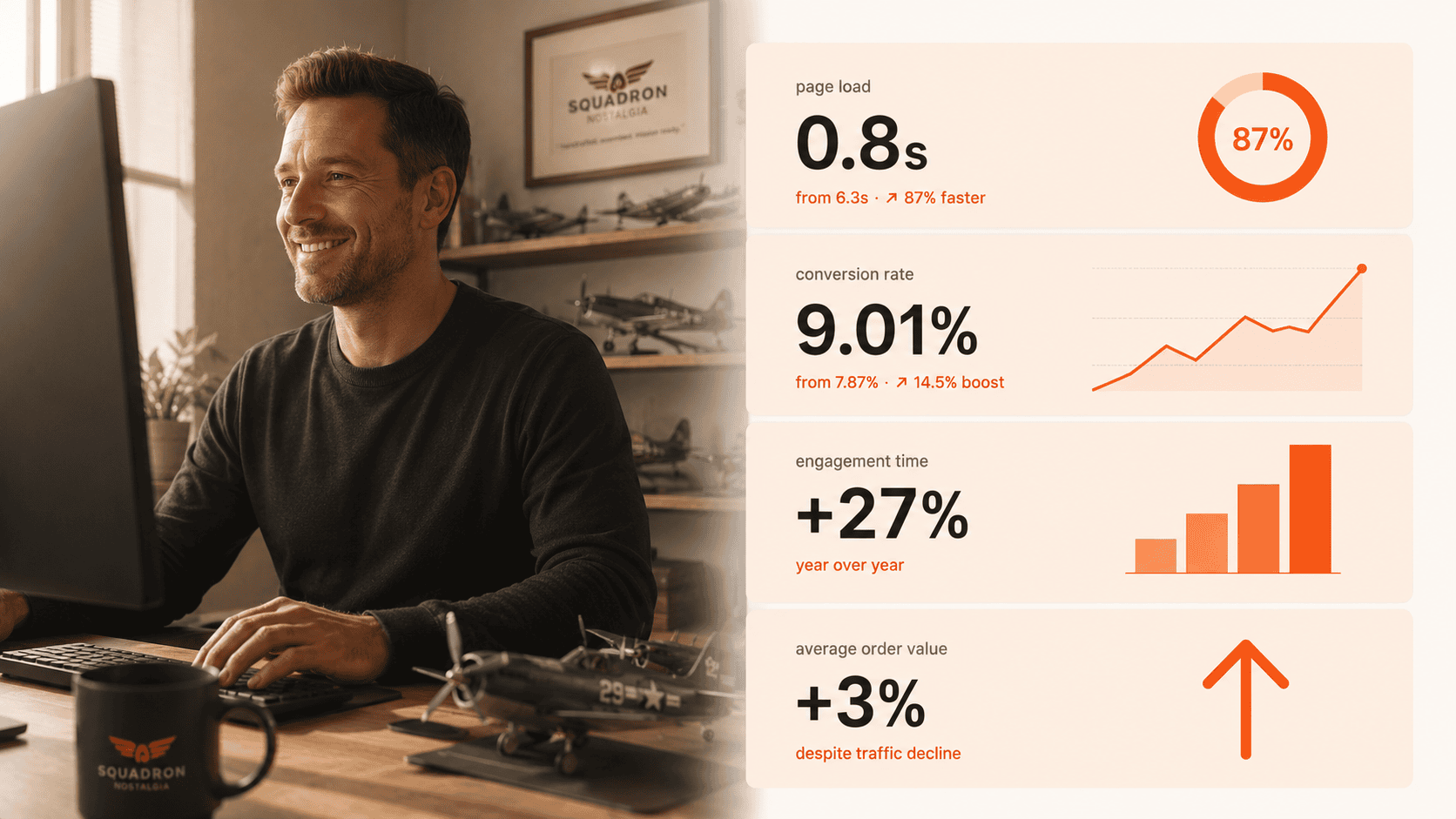
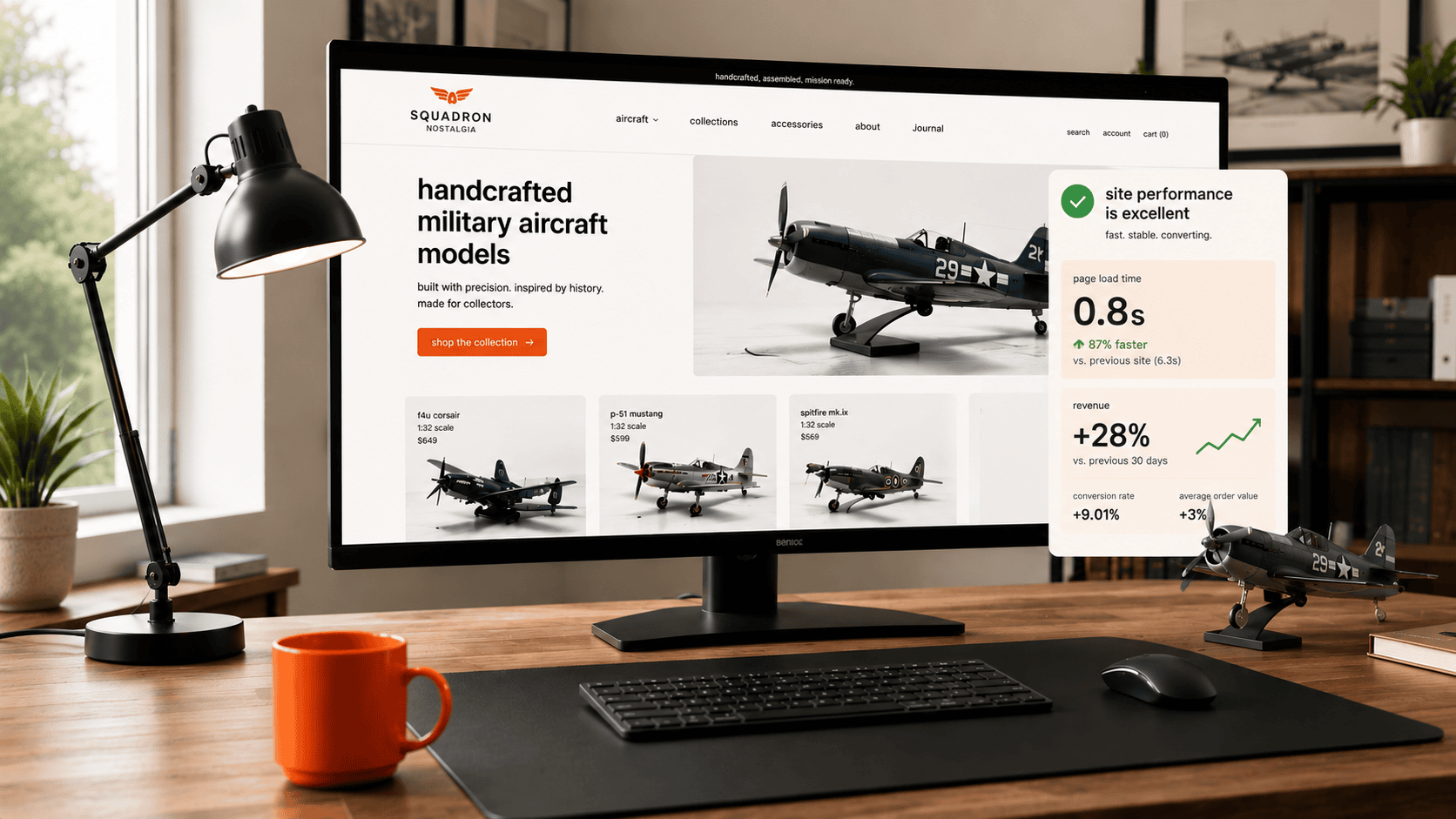
- Page loads: 6.3 seconds → 0.8 seconds (87% improvement)
- Sub-second performance globally
- Zero performance-related cart abandonment
Engagement Metrics:
- 27% increase in average engagement time
- 18.3% boost in engagement rate
- 14.5% conversion rate improvement (7.87% → 9.01%)
- Mobile engagement recovered: 49.31% → 51.88%
Business Impact:
- Maintained revenue despite 12% traffic decline from algorithm changes
- 3% increase in average order value
- Eliminated the $70/month Doofinder subscription by building search natively into the frontend
- Positioned for 20-30% growth when traffic recovers
Want similar results? Get your WooCommerce Revenue Audit to see exactly where you’re losing conversions – and whether headless or optimization fits your store.
Channel Performance:
The improvements transformed Squadron Nostalgia’s most valuable traffic. Paid search now delivers 64.68% engagement with 1m 47s session times – their highest performing channel. Every marketing dollar now converts 14.5% better.
Client Perspective: From Skeptic to Advocate
Nathan’s journey from DIY frustration to professional partnership:
During Implementation:
“I’m really impressed with the design. I was initially a little nervous due to complexity of the subject matter, but you nailed it.”
Post-Launch Assessment:
- Performance: 4.5/5 – “100% better than my old site”
- Communication: 5/5 – “The team was easy to work with and pleasant”
- Alignment: “Exactly as expected”
Six Months Later:
“Your team responds right away to fix anything… Things have stabilized a lot… I would give my top referral to anyone looking to build an ecommerce site.”
Google Review · ★★★★★:
“Great team to work with and great result. When they say ‘blaze’ they aren’t kidding. The results on my website were dramatic. If you have a WordPress site that is sluggish, the headless WooCommerce will be the change you need.”
– Nathan Rocklein, Founder, Squadron Nostalgia
The Strategic Victory: Long-Term Partnership Value
Six months post-launch, Squadron Nostalgia has what Nathan never achieved in 10 years of DIY development: stability, performance, and peace of mind.
Ongoing Partnership Includes:
- Weekly communication and support
- Constant updates and improvements
- Immediate response to any issues
- Proactive optimization recommendations
Nathan’s feedback captures the difference: “The only downside I had was the timeline went longer than expected, but the end result was worth it and would give my full endorsement to this company and their team.”
Lessons for Similar Businesses
Squadron Nostalgia proves three critical points:
- Technical debt compounds: 80 plugins and 10 years of bandaids couldn’t match proper architecture
- Specialization matters: WooCommerce-only expertise delivers what generalists can’t
- Performance drives revenue: Even with traffic challenges, better conversion rates maintain growth
For high-volume stores serving passionate niche audiences with complex requirements, the investment in proper infrastructure pays for itself. Squadron Nostalgia positioned themselves for significant growth – when their organic traffic recovers, they’ll capture 14.5% more value from every visitor. For smaller stores, the same speed is reachable through WooCommerce optimization without going headless.
Frequently Asked Questions
Should my store go headless?
Probably not – and that is the honest answer. Headless is the right call for high-volume stores, roughly $3M/year and up, where a large catalog or heavy traffic strains the architecture, as it did for Squadron Nostalgia. Below that line, a headless build is hard to justify when WooCommerce optimization reaches the same half-second page loads for a fraction of the cost. Our when not to go headless with WooCommerce guide walks through where the line sits, and a WooCommerce Revenue Audit tells you which side of it your store is on.
How did Squadron Nostalgia reach 0.8-second page loads?
Through a headless WooCommerce build on React/Next.js, served from a global CDN, which renders pages as static or server-rendered HTML instead of building them in the browser on every request. Combined with cleaning up 1.2 million orphaned image files and cutting the plugin load, that took page loads from 6.3 seconds to 0.8 seconds – an 87% improvement – while keeping the full WooCommerce backend in place.
Did going headless change how the team manages the store?
No. Nathan and his team use the same WooCommerce admin for products, orders, and fulfillment, and every integration – accounting, CRM, shipping, 3PL, and payment gateways – kept working as before. Changes sync to the live frontend within seconds. The change was on the frontend the shopper sees, not the backend the team works in.
Can a smaller store get this kind of speed without going headless?
For most stores, yes. The speed shoppers feel comes from the same fundamentals – efficient rendering, optimized images, caching, and a lean frontend – and those can be applied to an existing WooCommerce store through optimization. Austin Natural Mattress and Henry Holsters are two stores that reached high performance that way, without going headless.
Did the headless build affect SEO or existing URLs?
No. Squadron Nostalgia kept the same URLs, the same content, and the same orders and customer data. Faster page loads and a cleaner mobile experience help SEO, not hurt it. The site maintained revenue even through a 12% traffic decline driven by external algorithm changes, and is positioned for 20-30% growth as traffic recovers.
Is the headless storefront accessible?
Yes. The React/Next.js frontend ships semantic, keyboard-navigable markup with proper heading structure, descriptive alt text, visible focus states, and color contrast meeting WCAG 2.1 AA. Accessibility is part of the UX layer of our diagnostic process, not a separate add-on.
Ready to Transform Your WooCommerce Store?
See how your store measures up with a WooCommerce Revenue Audit, or explore whether headless WooCommerce is the right call for your business – and when it isn’t.
Related Success Stories:
- Gourmet Basket: 0.223s Load Times & 30% AOV Increase
- Byron Bay Candles: Mobile UX Transformation
- Jackie Mack Designs: Conversion Rate Masterpiece
- LiteracyWorks: Near-Perfect Performance Achievement
Schedule Your Strategy Call | View All Client Success Stories